
Tragic Tale of the Girl in Blue
by M.P. Pellicer | Noir Notebook
No one knew who she was, and without any identification, the townspeople donated money and buried the girl in the local cemetery, naming her the “Girl in Blue” as this was the color she was wearing when she was found.

1933
Christmas was two days away, and a young woman dressed in a navy blue skirt came to the ticket window at a Greyhound bus station, and asked about fare to Erie, Pennsylvania and Elmira, New York. She eventually purchased a ticket to Willoughby, Ohio.
Once she arrived there, a kindly stranger directed her to a boarding house owned by Mary Judd on Second Street. Evening was falling when she arrived, and she told Mrs. Judd her name was “Kate” and nothing else about herself.
The next morning, she sat down to read in the rest area, waiting for breakfast to be served. During the meal, she asked Mrs. Judd for directions to the main bus station and the local church. At 11 a.m., she headed off towards the downtown area of the town.
An hour later, she returned, looking a “little worried” and went to her room. When she came downstairs, she carried her suitcase and handed the surprised landlady the key. The girl settled her bill and, on the way out, said, “Merry Christmas”.
Others recalled seeing her one block south of the boarding house, walking along a street that ended in a copse of maple trees. She stepped into the woods and disappeared.
No doubt this odd behavior kept the witnesses watching the area, wondering what she was doing.
Emerging on the other side of the woods, she was faced with the railroad tracks stretching off into the distance. Suddenly, there was an eastbound flyer heading to New York barreling down the track at her doing about sixty-five miles per hour. She was seen to drop her suitcase and then she sprinted toward the tracks. A glancing blow from the train sent her slight body hurtling through the air, landing on the gravel siding. Her short-lived life was tragically over.
– Haunted Willoughby, Ohio by Cathi Weber (2010)
People ran to where she lay, and someone called the police. There was no doubt she was dead, but they couldn’t find any wounds or blood on her. Inside her purse, she had 90 cents, a railroad ticket to Corry, Pennsylvania, a handkerchief, trinkets, and nothing to identify her.
Later, it would be found out that two days earlier, she had been kicked off a streetcar in Kirtland after failing to pay her fare.
Her suitcase was found nearby, but it only contained a towel, pencils, and envelopes. Again, there was nothing to help authorities give her a name.
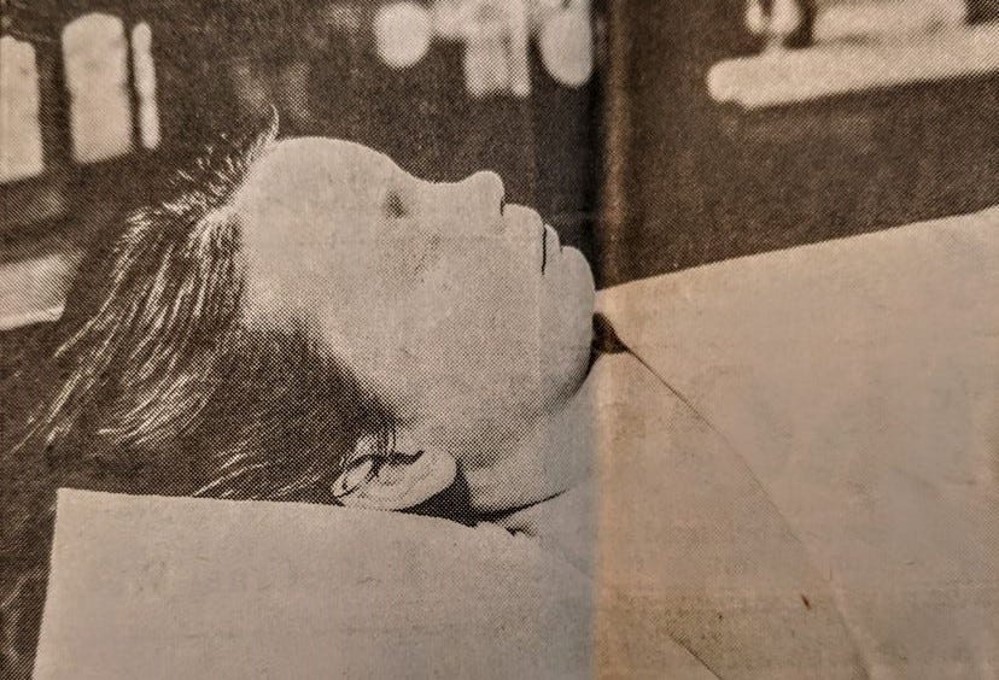
The body was taken to a local funeral home. James McMahon, the undertaker, examined the girl and concluded she died from injuries sustained in the train accident. Her cause of death was listed as a fractured skull. She was five feet four inches tall, weighed 135 pounds, and had reddish brown hair and hazel eyes. Her teeth were straight, and she had high cheekbones, and he guessed she was born of foreign parents.
She was laid out for two weeks. More than 3,000 residents visited to pay their respects and see if they could identify her, but no one came forward to say they knew her. Perhaps because of her youth and prettiness, Mr. McMahon decided to give her a proper funeral. The story about the mysterious girl killed by a train appeared in more newspapers, and families called, hoping she might be someone they had lost, but in the end, she was never claimed.
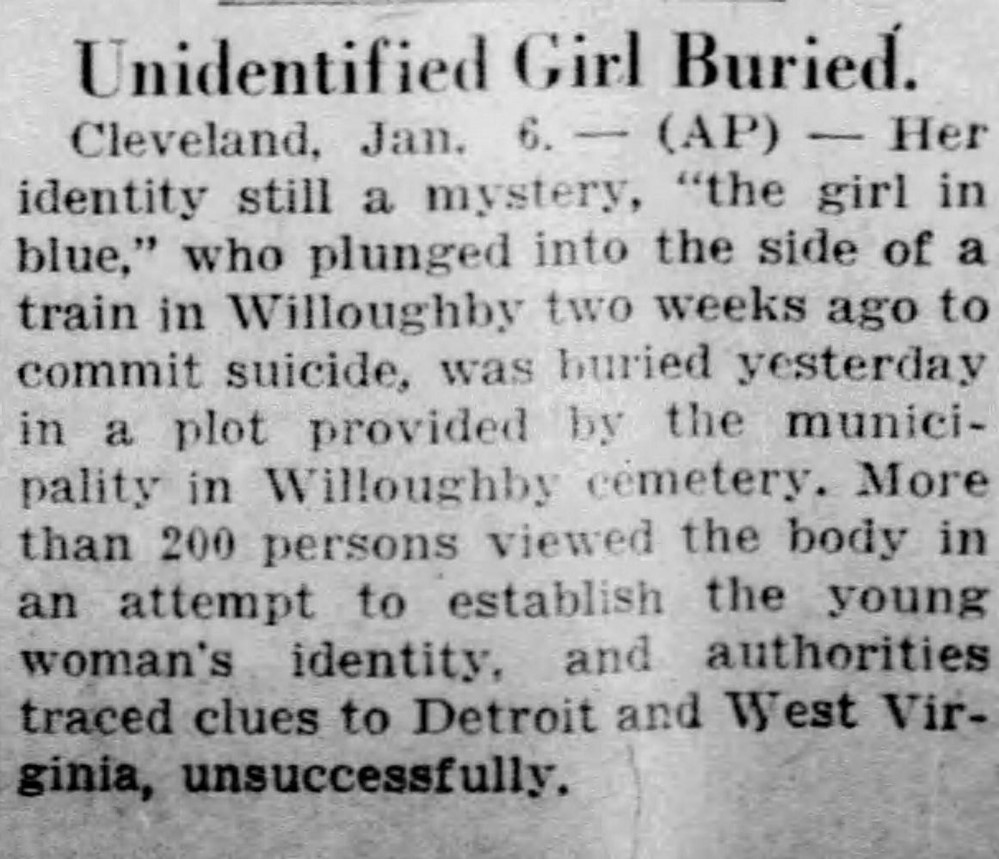
Willoughby residents raised $60 for a headstone, and the Girl in Blue was laid to rest in Willoughby Cemetery in a plot donated by a resident. An additional $15 was placed in a city fund to ensure geraniums would be placed on the grave once a year.
She was buried on January 5, 1934. Because she was wearing a blue woolen dress and blue shoes, she was from then on known as “The Girl in Blue.”
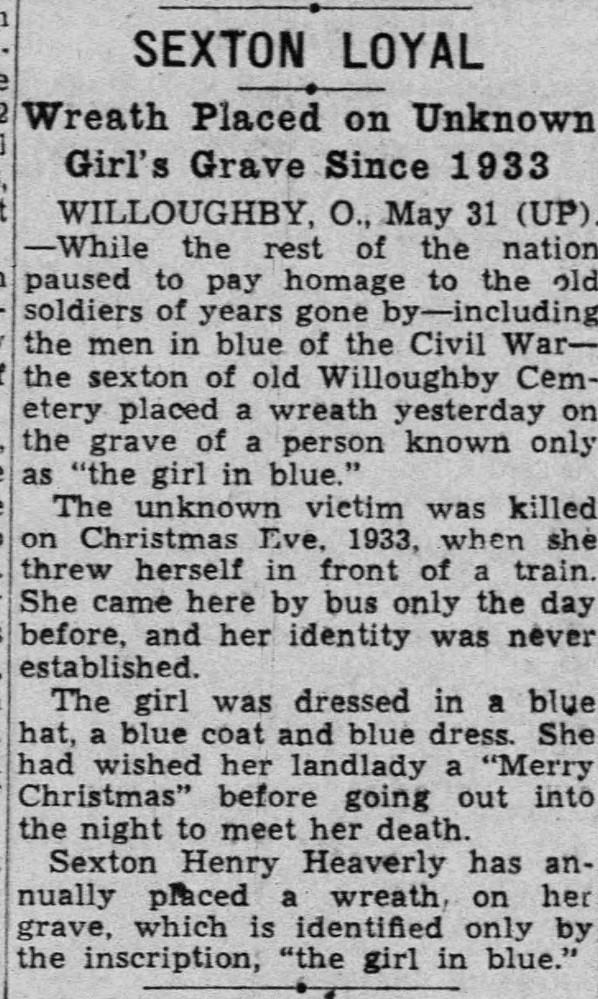
Henry “Hank” Heaverly, the sexton, took it upon himself to raise donations for a memorial. In 1936, he was still trying to get the $30 needed, after E. D. Rich & Sons agreed to sell the stone at cost. Eventually, he raised some money and contributed some of his own. He would place a wreath on her grave every year.
At Christmas, residents would make a pilgrimage to the grave, which, through contributions received perpetual care. An evergreen was donated by someone in Maine, which grew on the plot, and each year, strangers would send flowers to the “girl in blue”, believing she might have been their daughter.
Even though it was never clarified one way or another, it was believed that the poor girl had committed suicide.
In April 1934, it was believed the mystery had been solved. She was thought to be Mary Dalbaugh, 20. Her aunt and two younger sisters, inmates of a children’s home in West Virginia, were convinced that pictures of the dead girl were their sister. Then Mary called her family to say she was alive and living in Maryland.
Hopes were raised again in May when she was identified as Mrs. Elsie Goodwin. She had disappeared from her home since October 1933, and her husband supplied a photograph of his missing wife as proof. Her sister Josephine Tenant from Steubenville examined the girl’s personal effects and said they belonged to Mrs. Goodwin. Her husband was emphatic that she had not committed suicide.
Mr. Goodwin was ready to order a headstone when he received a phone call that his supposedly dead wife was alive and living in Columbus, Ohio. In other words, she’d walked out on him and her two kids, after originally leaving a letter, she was going to visit her mother.
In May 1936, Leo Klimczak and Eva, his sister, studied the photographs of the dead girl, and he said she might be his sister Josephine. He said his sister went to Erie, Pennsylvania, on December 23, 1933, and boarded a bus for Detroit. The family had not heard from her again. In July, two detectives spoke to Willoughby’s police chief and confirmed the dead girl was Josephine Klimczak of Spartansburg, Pennsylvania.
For some reason, after this article was published, no further reference was made to this disclosure, considering how close to the truth it actually was.


Although most historians agreed the girl’s name was “Sophie,” her last name was the center of debate for 60 years.
It wasn’t until December 1993 when The News-Herald published an article marking the anniversary of the Girl in Blue’s death. A Pennsylvania real-estate agent, Lauri Sekerak, recognized the girl. She had been selling the former Klimczak family farm in Spring Creek at the time. Sekerak’s involvement in the Klimczak property was establishing a clear title to the property for Quaker State Oil Company, since the farm had changed hands through several years.
Sekerak discovered through court records that the mystery girl was Josephine “Sophie” Klimczak. Her parents were Polish immigrants who both died in 1935, two years after their daughter disappeared.
After the senior Klimczaks died, the farm was sold in 1941. She came across an affidavit from Leo Klimczak dated November 22, 1985, stating that among Jacob Klimczak’s heirs were his wife, Catherine, and a daughter, Josephine Klimczak. His mother, Catherine, died six months after her husband without remarrying, and Josephine Klimczak was killed in an accident in Willoughby on December 24, 1933, was unmarried… and had not been identified until after the death of Jacob Klimczak.”
Josephine was finally identified by her brother Leo and another sister, Eva Klimczak, “from photographs of the body and items of personal belongings held by the authorities.”
It turned out that Sophie had worked as a waitress in Detroit, and her brother Leo had asked that her name should not be revealed. She was one of nine children, five sisters and three brothers. Leo Klimczak not only kept the secret from the public but from her parents, who went to their graves without knowing what happened to their daughter.
Eva Klimczak believed that her brother never came forward with their sister’s identity, believing Josephine had committed suicide, and the Catholic church would forbid her burial in a Catholic cemetery. This was also right after the Great Depression, and he might have feared they would have to pay to exhume and rebury her.
Upon learning that Sekerak could confirm the identity of the Girl in Blue, Willoughby lawyer William C. Gargiulo came forward and asked that Lake County Probate Court Judge Fred V. Skok officially recognize the true identity of the girl.
Gargiulo approached the McMahon-Coyne Funeral Home in 1993 to see if a fund could be established to buy an additional tombstone listing the girl’s true identity.
Kotecki Monuments offered to donate a small tombstone, but money was never collected, and the additional tombstone was never put on her grave.
When The News-Herald ran a story revisiting the Girl In Blue in 2002, his son Ed Kotecki IV, who ran the company then, said he would still be willing to donate a tombstone. The original stone was left intact.
The mystery remains as to why young Josephine arrived in Willoughby penniless, and her purpose for visiting the town is still unknown.