


Ten Miles to Nowhere: The Unsolved Vanishing of Marvin Alvin Clark
by M.P. Pellicer | Noir Notebook
On Saturday, October 30, 1926—the day before Halloween—Marvin Alvin Clark, once the marshal of the small lumber town of Linnton, Oregon, climbed aboard a motor stage bound for Portland. He never arrived. No one has seen him since.
Clark was born in Iowa in 1852. With his wife, Mary Ann Leach (née Lewis), a young widow already raising three children, he settled in Linnton, where he served as town marshal.
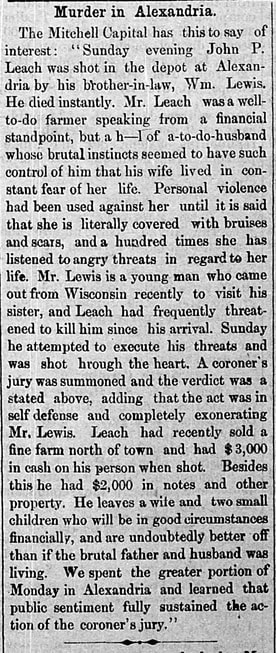
Mary Ann carried her own dark history. Her first husband, John Perry Leach, a “well-to-do farmer” by the newspapers’ financial measure but a brutal husband by every other, had beaten her so severely that bruises and scars covered her body. She lived in constant fear for her life.
In November 1882, while the family lived in Dakota Territory, Mary Ann’s twenty-year-old brother, William Lewis, visited from Wisconsin. Leach threatened to kill him too. At the railway station waiting room in Alexandria, the two men fought. Leach, thirty-two and a veteran of Wisconsin’s Volunteer Infantry with a prior record of violence—including a jailhouse rampage and a knife fight—threw the younger man to the floor. Lewis drew a revolver and fired three shots. The last struck Leach in the heart. A coroner’s jury ruled the killing self-defense.
William Lewis would go on to join Roosevelt’s Rough Riders and took part in the Battle of San Juan Hill. He didn’t die in combat, but passed shortly thereafter in 1900. He had contracted a pulmonary disease while serving. He was only 39 years old.
One good thing Leach did for his widow was to leave her roughly five thousand dollars from the sale of a farm. Three years later, on February 21, 1885, Mary Ann married Marvin Clark. By 1888 the couple had moved west, eventually settling near Tigard. They raised five more children together.
Clark knew the country above the St. Helens Highway intimately; townspeople recognized him on sight. At seventy-three, he walked with a pronounced limp from partial paralysis on one side of his body, wore wire-rimmed eyeglasses, and favored leather high-top boots.
The trip from Tigard to Portland covered only ten miles. Two days passed before Mary Ann realized her husband had never reached his stepdaughter Sidney McDougall’s home at the Hereford Hotel at 735 Hoyt Street, which Sidney managed. She later told investigators the visit had been unplanned since Clark had stopped by only a few days earlier.
Police learned someone had seen him at the Salmon Street terminal.
Newspapers first reported the disappearance on November 6.
On November 19, a postcard arrived from Bellingham, Washington, purportedly from Marvin. Witnesses claimed they saw a man matching his description there on November 2 or 3. Whether the card was a cruel joke or the product of a disoriented mind, no one ever determined.
Clark stood about five feet eight, weighed roughly 170 pounds, and had gray eyes, white hair, and a white mustache. Partial paralysis forced him to walk with a “hanging gait.” The family feared he had fallen ill and could not identify himself. They checked hospitals and undertakers across the region without success, posted a one-hundred-dollar reward, and circulated notices to police departments throughout the Northwest. The reward went unclaimed.
Mary Ann died in 1930, never knowing what happened to her husband.
Sixty years later, on May 10, 1986, loggers working a secluded ravine in northwest Multnomah County—land once part of Linnton—unearthed a full male skeleton. Beside it lay a Harrington & Richards .32-caliber revolver with one expended cartridge. Among the remains were an 1888 nickel, an 1881 silver dollar, and an 1896 quarter—tavern tokens common between 1890 and 1920—along with a Sears, Roebuck pocket watch, a mechanical pencil, wire-rimmed eyeglasses, and a Fraternal Order of Eagles pocket knife. The man wore high-top “police loafers” of the style popular in the 1920s. The medical examiner ruled the death a suicide: a contact wound to the skull with the bullet exiting at the temple. The remains appeared to date from the early 1920s. The man stood approximately five feet nine and was estimated to have been between thirty-five and fifty-five years old.
Dorothy Willoughby, Clark’s granddaughter, contacted detectives at once. She believed the skeleton belonged to her grandfather, who had grown depressed over medical problems and sometimes used a cane. The family had also suffered the loss of daughter Myra in 1921 after severe burns from cooking grease.
Dorothy died in 1991 before definitive identification. In 2011, investigators extracted DNA from the bones. By 2014, three paternal great-great-grandchildren produced encouraging but inconclusive results. In 2018, Pam Knowles, another great-great-granddaughter, and her son submitted samples. The DNA did not match. The skeleton was not Marvin Clark.
For decades, Clark’s case held the title of the oldest active missing-person investigation in the United States. In 2011, records elevated an even older file: Elijah Gersham (or Gershom) “Life” Cravens, a farmer outside Okmulgee City, Oklahoma.
On or about January 1, 1902, Cravens left home to attend a Woodmen of the World lodge meeting and never returned. The Muskogee lodge met on the first and third Thursdays; he was likely headed to the January 2 meeting forty miles east.
Oklahoma was still Indian Territory then. Cravens was about thirty-seven, slim, and under six feet. He had married twice and fathered four children. No John Doe has ever matched him, and the passage of more than a century has left investigators with almost nothing to examine.
Marvin Clark’s ten-mile journey remains unfinished. A postcard, a possible sighting, a skeleton that proved to be someone else, and DNA that closed one false lead—all of it only deepens the silence that began the day before Halloween in 1926.

