Collinwood Never Sleeps: The Pageants, Hauntings, and Buried Secrets of Dark Shadows
Some stories drift out of the past like fog over a moonlit graveyard, half-forgotten but impossible to shake. Such is the tale of Miss Ghost America, a peculiar pageant born in the twilight of television’s most brooding gothic soap opera. In 1970 and 1971, as fans clung to every whispered secret of Collinwood, the creators of Dark Shadows summoned a nationwide search for the girl with the perfect “vampire look.” What followed was a strange parade of fangs, capes, and crowns, with a legendary activist, a disastrous date, and a resurrection or two along the way.
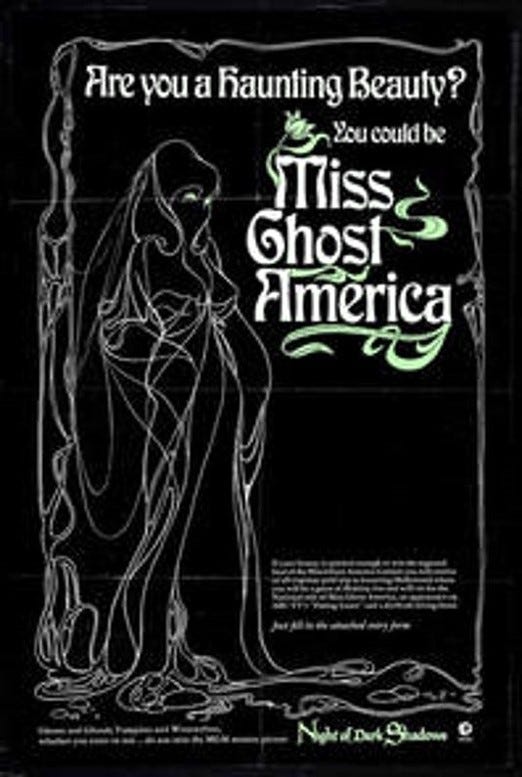
Miss Ghost America
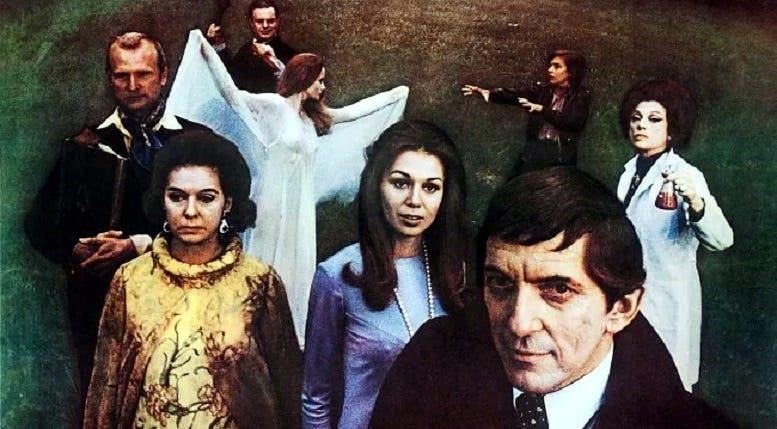
Long before Anne Rice conjured her velvet-voiced vampires, and before the fictional Louisiana town of Bon Temps drew viewers into the sultry world of True Blood, the 1960s soap opera Dark Shadows already had its own brooding vampire and a restless werewolf prowling the shadows. The series ran from 1966 to 1971 before vanishing from the airwaves after 1,225 haunting episodes. So devoted was its following that two feature films were made with the original cast: House of Dark Shadows in 1970 and Night of Dark Shadows in 1971. To lure audiences into theaters, the producers sponsored a nationwide pageant steeped in spooky glamour.
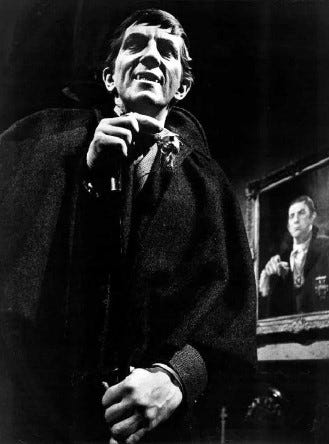
Like the series, the films centered on the tormented Barnabas Collins, a vampire from the eighteenth century who haunts the family estate disguised as a modern-day relative. Above all else, he longs to shed his cursed immortality and become human, so that he might marry a mortal woman.
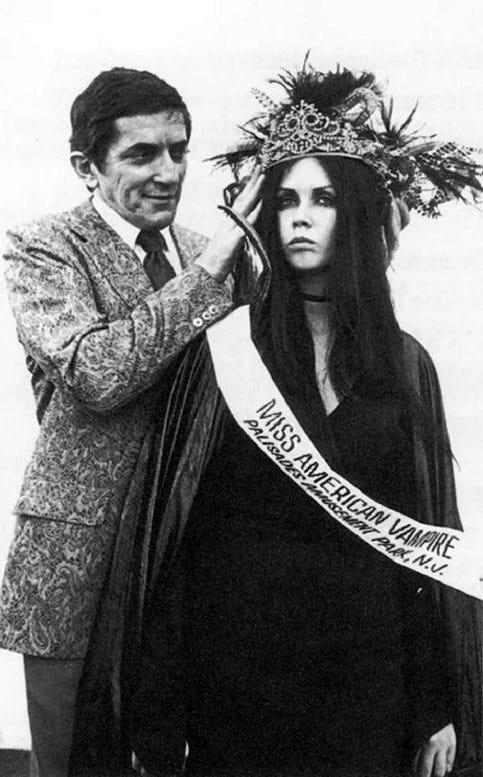
MGM and the series’ mastermind, Dan Curtis, believed a beauty contest would draw the faithful out of the darkness. The winner of the Miss American Vampire Contest would receive a trip to New York and a guest appearance on a television episode.
Newspaper advertisements beckoned to young women between 18 and 25 who believed they possessed the right “vampire look,” along with “charm, poise, stage presence and videogenic qualities for television.”
One television spot promised, “It’s a contest you can sink your teeth into.”
Regional contests were held in cities across the country, from Dallas to Philadelphia to Miami. The finalists were summoned to Los Angeles for the grand competition on September 10, 1970. A New Jersey judge later recalled the evening in The Dark Shadows Companion: 25th Anniversary Collection: “It was fun for the first five minutes. After that it got terribly depressing. Some of the girls came in bikinis. Some of them came dressed as witches or vampires or dead bodies. One girl stood in front of me and just stared.”
The winner was actress Sacheen Littlefeather (1946–2022, born Maria Louise Cruz), who three years later would take the stage at the 1973 Academy Awards on behalf of Marlon Brando. She declined the trip to New York and the television appearance, and the prize passed to Christine Domaniecki, the New Jersey winner, who had been crowned by Jonathan Frid (1924–2012), the actor who portrayed Barnabas Collins.
The contest proved so popular that the spell was cast again. After the release of House of Dark Shadows and the series’ final episode in April 1971, Night of Dark Shadows arrived in August. This second film turned its gaze to Angelique, the vengeful witch who cursed Barnabas with vampirism. A new competition, Miss Ghost America, rose from the crypt with the same format as the first. With the series now silenced, the prize was an appearance on The Dating Game.
The finals aired on Fright Night in Los Angeles on September 25, 1971. Eighteen-year-old Kate Sarchet took the crown, along with a $250 savings bond and her turn on The Dating Game. Her bachelor was the comedian Will Durst, who later wrote of a date that never earned a second: “Miss Ghost America totally ignored me on the date and hooked up with the golf pro at the hotel where we got a free round of golf, which left the chaperone and me to drink in the hotel bar. Drank so much that I missed the ride back to LA the following morning, and I had to get back on my own.”
A Second Awakening
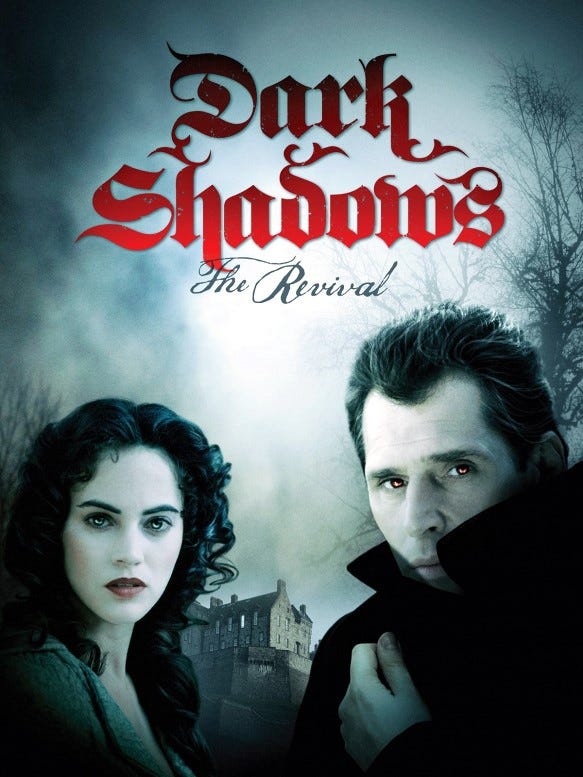
In 1991, the gothic soap opera clawed its way back from the grave as Dark Shadows: The Revival, a television series developed once more by Dan Curtis. Filming took place largely at the Greystone Park and Mansion in Beverly Hills, whose shadowed halls lent the production its haunting atmosphere. Some of the period wardrobe had originally been worn in the 1988 film Dangerous Liaisons.
Ben Cross (1947–2020) took on the role of Barnabas Collins. Yet NBC cancelled the series after a single season. Devoted fans answered with more than 7,000 letters of protest, and some picketed outside the network’s headquarters in Los Angeles and New York City.
Shadows Behind the Shadows: Hauntings, Scandals, and Secrets
Every legend casts a second shadow, and the tale of Dark Shadows is no exception. Behind the candlelit corridors of Collinwood lay a world stranger than any script: a nightmare that may not have been Dan Curtis’s own, a leading man pursued by devotees who believed his vampire was real, studios raised upon restless ground, and an episode that was whispered to have vanished into the dark. What follows is the story behind the story.
The Idea of Dark Shadows
Shadows on the Wall was the original working title of the soap opera, discarded for Dark Shadows only shortly before the first episode was broadcast. Creator Dan Curtis claimed the idea came to him as a nightmare in 1965: a young woman aboard a train, traveling toward a mysterious mansion that would become the nexus of the entire storyline.
Not everyone believed him. In 1973, Doris Hursley, a writer for General Hospital, filed a claim of copyright infringement. Curtis, she said, had attended a writers’ workshop where she presented the outline of her story House on Widow’s Hill, whose heroine was hired as a governess at an estate plagued by supernatural events. The matter was settled out of court, sealed beneath a gag order.
It is also alleged that film historian Jim Pierson discovered that, during the 1960s, Curtis had bought the rights to several Gothic novels, including Rebecca and The Uninvited, in order to borrow from their storylines. The traces are there to be found. Dark Shadows drew heavily on the tropes of Rebecca: a new wife, a dead and glamorous predecessor, a hostile housekeeper. They surfaced in the 1970 Parallel Time storyline and again in Night of Dark Shadows, yet the series never once credited du Maurier. The Uninvited began as Dorothy Macardle’s 1941 novel Uneasy Freehold, published in the United States under its new title and filmed by Paramount in 1944. Pierson’s published accounts list an option or purchase of the book, though it is cited only as one of the gothic-house films Curtis was imitating.
The series itself nearly perished during its first season. Only the arrival of Barnabas Collins, played by Jonathan Frid, saved it. Frid was hired for just three weeks, but after his introduction the ratings soared to a reported 20 million daily viewers, and the soap became one of the most profitable shows on the network.
A trained actor, Frid expected a brief stint before departing for a job waiting for him in California. Instead, the role became both a blessing and a curse. Fans who believed Barnabas Collins was real sent death threats, demanding that Frid reveal his location. Others wrote begging to marry him. Letters arrived at an average of 5,000 a week. One unverified story tells of a woman who broke into his apartment in 1969, claiming Barnabas had invited her. She was found in his bed in a period nightgown, with two wine glasses of cherry Kool-Aid standing in for blood. Security was tightened. Frid moved four times in three years and stopped signing autographs in person.

Shadows on a Shoestring
The show was performed live, with no retakes. Everything aired exactly as it was filmed, forgotten lines and bloopers included, and each stumble had to be disguised in the moment.
The budget was famously meager, reported as only $200 a week. The celebrated portrait of Barnabas Collins that hung in the entryway of the Collins mansion was painted by Frid’s roommate for $75 and a case of beer. At some point, it was stolen from the studio, and a duplicate was made. The original has never been recovered.
Curtis was known to verbally abuse his actors before scenes, stirring them into raw and authentic reactions.
Location, Location, Location
The exteriors of the brooding 40-room Collinwood mansion were in reality the Seaview Terrace (also known as the Carey Mansion) in Newport, Rhode Island.
The brooding facade that greeted viewers as Collinwood is no painted illusion. It belongs to a real mansion on the cliffs of Newport, Rhode Island, known as Seaview Terrace, and later as Carey Mansion. Some say it was never merely a set but a house with a restless life of its own.
Construction began in 1907 under the direction of Edson Bradley, a whiskey magnate who commissioned the architect Howard Greenley to design a palatial summer retreat. Bradley spared no expense. He imported entire rooms from European châteaux, determined to conjure an authentic French atmosphere upon the Rhode Island shore. The project would not be finished until 1925, built from the salvaged bones of demolished French and Italian estates. Even in its first stones, the mansion was a patchwork of other places and other ghosts.
When Bradley died in 1935, he left the house to his widow, Julia. The Bradley years were marked by opulence and personal tragedy, and multiple deaths were said to have occurred within the mansion’s walls. Even then, servants whispered of strange occurrences, though their accounts were dismissed as superstition.
In 1949, the Carey family purchased the estate and renamed it Carey Mansion. George Carey, a utilities executive, made it his primary residence, but peace did not follow him through the doors. His family experienced unexplained phenomena almost immediately, including cold spots in the bedrooms that persisted despite the mansion’s modern heating system.
Salve Regina University acquired Seaview Terrace in the 1970s and converted it into student housing called Founders Hall. Generations of students have since slept within its allegedly haunted walls, and the university is said to keep detailed records of the unexplained incidents they report.
Shadow figures are the most commonly reported phenomenon. Witnesses describe human-shaped darkness gliding through hallways and rooms with a will of its own, most often in the Grand Hall and along the third-floor corridor. The shadows sometimes pause, as if observing the living, before continuing their mysterious journeys.
Disembodied footsteps echo through the mansion at all hours. Students speak of heavy boots climbing the main staircase when no one is there. The steps often halt outside bedroom doors, followed by a complete and terrible silence, and door handles sometimes turn although no one has entered.
Objects move without explanation. Books are said to fly from the shelves of what are now study areas. Furniture repositions itself overnight in locked rooms, and personal belongings vanish, only to reappear days later in impossible places.
Cold spots manifest suddenly, regardless of season or thermostat, with temperatures dropping by as much as twenty degrees within a few feet. The chill often drifts across a room as though an invisible presence were walking past, and those caught within it report the unmistakable sensation of being watched.
Phantom music drifts through the ballroom in the late evening hours, melodies that sound like orchestral pieces from the early twentieth century. No source has ever been found, despite extensive searches. It is heard most often in the autumn and winter months, when the nights grow long, and the sea wind presses against the glass.
Perhaps it is no coincidence that the producers of Dark Shadows chose this house for their gothic family seat. Or perhaps the house chose them.
For the 1970 and 1971 films House of Dark Shadows and Night of Dark Shadows, the exterior shots were filmed at Lyndhurst Mansion in Tarrytown, New York. Additionally, the exterior for Barnabas Collins’ “Old House” in the TV series was the Spratt Mansion (also known as The Colonnades), located next to Lyndhurst, which burned down in the late 1960s.
Inside Collinwood
The earliest episodes were shot at ABC’s TV-2 on West 67th Street. From 1966 to 1971, production moved to ABC’s Studio 16 at 433 West 53rd Street in Hell’s Kitchen.
TV-2 had been built inside the old riding ring of Durland’s Riding Academy, which opened in 1901 as a riding school and stable. Its ring, roughly 100 by 200 feet, lay beneath long roof trusses and balconies for spectators. Before the academy, the block was part of a late-nineteenth-century ring of stables and carriage houses serving the bridle paths of Central Park.
Close to both studios stood places acquainted with sudden and violent death. Across 66th Street rose the First Battery Armory at 56 West 66th, built in 1901 for the New York National Guard.
St. Elizabeth’s Hospital relocated in 1927 to Washington Heights from 415 West 51st Street, while the founding address was 225 West 31st Street. The hospital’s original name was the Hospital of St. Elizabeth of Hungary. It was operated by Franciscan nuns and opened as a small thirty-bed hospital.
In 1934, the Franciscan Sisters of Allegany took over the location as St. Clare’s Hospital to serve Manhattan’s Hell’s Kitchen neighborhood.
Whatever ghostly manifestations haunted the studios could have been the work of the many who lived and suffered on the land before the cameras ever arrived.
The Hell in Hell’s Kitchen
From the late nineteenth century into the 1980s, Hell’s Kitchen had a genuine pattern of gang violence and murder, and the name was no mere nickname. By the 1880s, newspapers were describing the blocks west of Eighth Avenue, roughly from the 30s to the 50s, as miserable, crime-ridden, and vice-ridden. One often-repeated origin story has a policeman in the 1880s declaring the place worse than hell. The neighborhood had already been swept up in the city’s convulsions: barricades rose on Ninth Avenue during the 1863 Draft Riots, and fighting tied to the Orange Riots of 1870 and 1871 followed.
Street gangs supplied most of the body count. After the Civil War, the Hell’s Kitchen Gang, the Tenth Avenue Gang, and others battled police and rivals alike. From the 1890s until about 1910, the Gophers, sometimes put at around 500 members, ruled much of the district, especially “Battle Row,” the stretch of West 39th Street between Tenth and Eleventh Avenues. They plundered rail and freight yards, brawled with police, and produced figures such as Owney Madden, later a Prohibition-era racketeer. Contemporary accounts and Herbert Asbury’s The Gangs of New York treat killings and near-killings as ordinary events in those fights. It was gang and saloon violence concentrated in a poor Irish and German waterfront district, not a measured homicide rate for every block.
The pattern carried into the twentieth century, reaching a second peak after World War II. In 1959, the “Capeman” killings, in which Salvador Agrón stabbed two teenagers in a Hell’s Kitchen playground, became a citywide scandal. From the 1960s into the mid-1980s, the Westies, a small Irish-American gang of perhaps a dozen to twenty members, ran rackets, loansharking, and contract killing from the neighborhood, often alongside Gambino and Genovese allies.
The reputation, it seems, was earned.
Eerie Events
Multiple cast members spoke of unsettling occurrences on the set. Kathryn Leigh Scott, who played Maggie Evans, complained of doors opening on their own and sudden pockets of cold. Director Lela Swift described equipment malfunctioning during the filming of supernatural scenes. Nancy Barrett, who played Carolyn Stoddard, refused to be filmed alone on the Old House set. She said a figure in Victorian dress watched her from the shadows. Security found nothing, yet two other cast members reported seeing the very same figure.
Could these have been revenants of the buildings and lives that once occupied the ground beneath the studios, or stood close by?
Shadowed Stars
Victoria Winters
Alexandra Isles, born Alexandra Cornelia von Moltke, who played Victoria Winters, was born in Sweden, the daughter of Count Carl Adam Moltke. In 1967, she married Philip Henry Isles II of the Lehman banking family, and in 1968 she left Dark Shadows because of pregnancy. Her darkest chapter came later. She was the mistress of Claus von Bülow and testified at his 1982 and 1985 trials for the attempted murder of his wife, Sunny. She was portrayed by Julie Hagerty in the 1990 film Reversal of Fortune, which dramatized these events.
Her testimony at the first trial helped convict him of trying to kill his heiress wife. Afterward, Isles reportedly hid in Europe to avoid testifying against the Danish socialite. At the retrial, testimony suggested she had hidden in part because the defendant sent her threatening letters after the first verdict. At the first trial, Isles testified that she had given von Bülow a six-month ultimatum to divorce his wife and marry her.
Martha “Sunny” von Bülow lingered in a vegetative state from 1980 until she died in 2008. Her husband was acquitted in 1985, after experts attributed her condition to self-induced drug and alcohol abuse exacerbating her hypoglycemia. Her family still believed he was responsible. She had inherited $100 million at the age of three, when her father died.
Elizabeth Stoddard
Joan Bennett took the role on Dark Shadows because she was broke and struggling to pay her bills. The job was meant to be a temporary one. Her film career stretched back to the 1920s, and the scandal that defined her Hollywood fame had unfolded almost two decades earlier.
In 1940, she married Walter Wanger (1894–1968), her third husband. They divorced in 1965 in Mexico.
For twelve years, Bennett was represented by the agent Jennings Lang. In 1951, they met at the MCA offices on Santa Monica Boulevard to discuss an upcoming television show, then drove off in Lang’s car.
Around 2:30 p.m., Bennett’s husband drove past the spot where she had left her car. He drove by a second time, saw it still parked, and decided to wait. Bennett and Lang returned a few hours later. As she prepared to drive away, Lang leaned against the car to talk with her. Wanger approached the convertible and fired twice. One bullet struck Lang in the thigh, the other in the groin. Bennett remembered only two flashes and Lang slumping to the ground. The moment she recognized the shooter, she told Wanger, “Get away and leave us alone.” He tossed the pistol into his wife’s car.
With the help of the parking lot’s manager, she took Lang to his doctor, and from there he went to the hospital, where he recovered. The lot lay across the street from the police station, and officers who heard the shots took Wanger into custody.
“I shot him because I thought he was breaking up my home,” Wanger told the Beverly Hills police chief. He was booked on suspicion of assault with intent to commit murder. Bennett denied any romance. “But if Walter thinks the relationship between Mr. Lang and myself is romantic or anything but strictly business, he is wrong,” she declared. She blamed the trouble on financial setbacks in the film productions Wanger was involved with, and said he was on the verge of a nervous breakdown. The following day, Wanger, out on bond, returned to their Holmby Hills home, collected his belongings, and moved out. Bennett insisted there would be no divorce.
Wanger’s attorney, Jerry Giesler, mounted a “temporary insanity” defense. Wanger served a four-month sentence at the County Honor Farm at Castaic, California, and returned quickly to his career, which concluded with the turbulent production of Cleopatra. Bennett, meanwhile, went to Chicago to take the stage as the young secret witch Gillian Holroyd in Bell, Book and Candle.
The incident placed Bennett on a black list, and her offers for roles dwindled away.
Mrs. Johnson
Clarice Blackburn (1921–1995), who played Mrs. Johnson, was allegedly a practicing witch, and was said to perform protective spells during certain scenes. She would halt mid-scene, declaring the energy wrong. Equipment would fail just when she predicted it would. She claimed to shield the cast from genuine supernatural presences on the set.
She died in 1995, having never married or had children.
The Lost Episode
Episode 1219, filmed in March 1971, was reportedly pulled at the last minute and never aired. The official explanation was technical difficulties. The rumored truth was far darker: a disturbing message involving the endangerment of children. Only the audio is said to have survived, and the full episode is allegedly lost for good.

What the Shadows Keep
Dark Shadows was never meant to last. A soap opera performed live on a shoestring, it should have died within a season. Instead, a reluctant vampire dragged it from the grave, and the audience that followed refused to let go. They wrote by the thousands, begged to marry a cursed man who did not exist, and sent threats to the actor who wore his fangs. When the cameras finally stopped, the faithful answered with crowns and costumes, and the pageants that followed were part spectacle, part séance.
But the true darkness gathered behind the scenes. A nightmare that may have been stolen. A portrait that vanished and never returned. Studios raised on ground soaked in gang blood, and an episode said to be silenced for reasons no one will speak aloud. Cast members felt cold in empty rooms and saw a figure in Victorian dress watching from the shadows. Their stars carried their own horrors, from a gunshot in a Hollywood parking lot to a murder trial that stretched across two continents.
Barnabas Collins spent every night longing to be mortal. His story chose the opposite fate. It cannot die, because it was never quite alive, and some things refuse to rest in the grave that was dug for them.
The candles at Collinwood have burned low. Yet on a quiet night, if you listen closely, a door still creaks open, and no one is there.
