

Between the Lanterns: The Living Ghosts and Yokai of Modern Japan

There are places in Japan where the past does not stay buried. It seeps through the floorboards of ordinary apartments, drifts along mountain trails, and lingers in the fluorescent light of office towers built over old execution grounds. For centuries, the Japanese have lived alongside yokai and yurei—monsters and ghosts that refuse to fade into mere story. Even now, in the heart of the modern world, people still report what they see, and the land itself is said to remember every death that was left unfinished.

Noir Notebook

Monsters and Ghosts

In Japan, belief in yokai and yurei is not confined to old folktales or horror films. It moves through everyday life. Creatures such as the Nopperabō, the faceless man who appears without warning on quiet streets, and the Kuchisake Onna, the slit-mouthed woman who asks strangers whether she is beautiful, are still reported by ordinary citizens. These encounters are not treated as mere imagination; they are sometimes taken seriously enough to reach the police.

Even the landscape of Tokyo carries old stains. Sunshine 60, the towering complex in Ikebukuro, rises on the site of Sugamo Prison. Once Japan’s most notorious prison, it opened in 1895 and remained active until the early 1960s. Among those hanged within its walls was former Prime Minister Hideki Tojo. After the prison was demolished in 1971, the land was redeveloped into a gleaming sixty-story complex of offices and shops. Its cheerful name was meant to drive away the old reputation. Yet the ground beneath it is still regarded by many as marked by bloodshed, and such places are never entirely trusted.

Land that has witnessed violent death is said to remain tainted. At the foot of Mount Fuji lies Aokigahara, the Sea of Trees, a dense forest long associated with suicide. Some trace its grim reputation to ancient stories of demons; others point simply to its isolation, where bodies can lie undiscovered for weeks. Whatever the cause, the paths are widely believed to be walked by yurei—vengeful spirits who cannot rest.

Suicide itself occupies a complicated place in Japanese tradition. Seppuku, the ritual self-disembowelment once practiced by samurai, was regarded as an honorable death rather than a shameful one. Even today, suicide remains one of the leading causes of death among younger adults. In the old understanding, a person who dies with strong unresolved emotion—especially betrayal, rage, or profound loneliness—may return. The Japanese term kodokushi, or “lonely death,” describes those who die alone and remain undiscovered for days or weeks. In such cases, the body and the stains it leaves behind are sometimes thought to open a passage through which the spirit can re-enter the world.
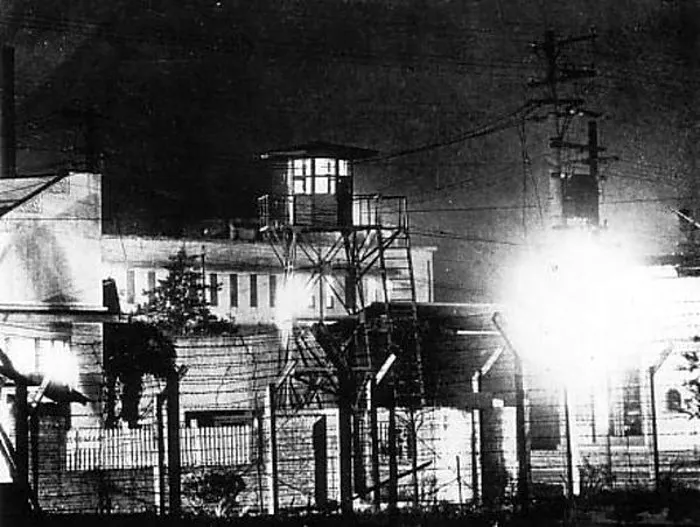
Sugamo Prison, Japan c.1948

Lonely Death

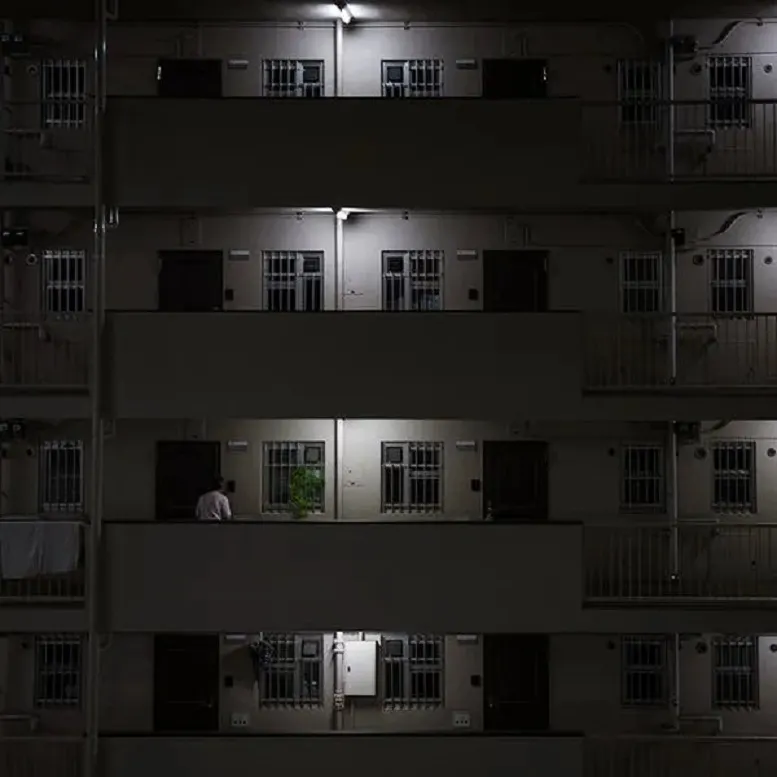
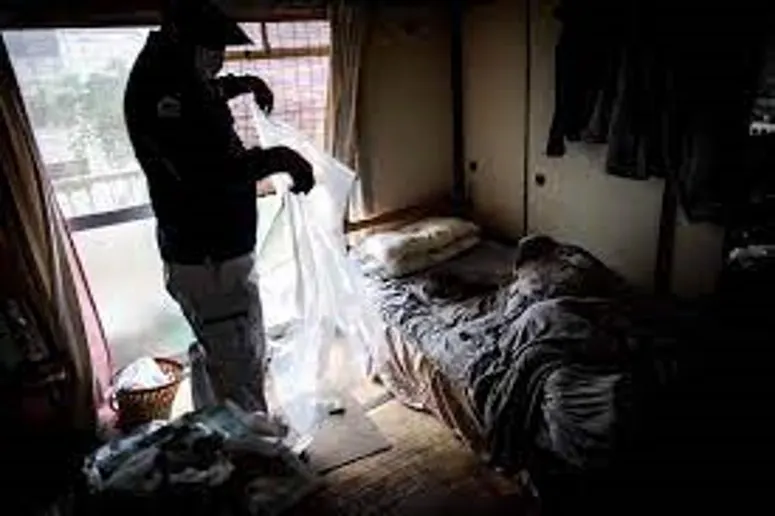
Japan’s aging society has made these deaths more common. With fewer multi-generational households and more elderly people living alone, many pass unnoticed. In places such as the Tokiwadaira apartment complex outside Tokyo, rows of nearly identical buildings house residents who often have no family or regular visitors. When someone dies, it is frequently the smell of decomposition that alerts the neighbors. One notorious case involved a man who lay dead for three years before his automatically paid rent finally ran out and police investigated. All that remained was a skeleton near the kitchen. The phenomenon has given rise to specialized cleaning companies that handle the aftermath of such deaths.

To soothe the restless dead, people still place small stone statues called jizo, guardian figures for children and travelers. People often dress them in red scarves and offer bean-curd cakes. Elsewhere, statues of tanuki—the shape-shifting raccoon dog—stand outside restaurants and bars. Both the tanuki and the kitsune, the fox, belong to the henge, a class of yokai capable of taking human form. Kitsune are linked to fertility and the rice harvest, able either to protect or to withhold it. The tanuki, once associated with omens and haunting, gradually became a more playful, mischievous figure in popular stories.

A tiny Tokyo apartment where a dead man lay decomposing for three weeks c.2017 (Source - AFP)
Tokiwadaira complex, Japan c.2017 (Source - NYTimes)

Stigmatized Properties

Other protective figures, such as the waving maneki-neko or the coin-holding toad, are milder, meant simply to invite prosperity. Far less benign are the ghost lights reported at sea after disasters. After the tsunami of the 1770s and again following the Fukushima accident, pale lights were seen drifting over the water. Official explanations speak of escaping gas. Tradition offers a different account.

More immediately feared are the jiko bukken—stigmatized properties. Japanese real-estate practice recognizes several categories of places considered psychologically harmful: buildings near organized crime, sites once owned by cults, locations built over wells (a recurring motif in folklore), properties close to crematoria or waste facilities, places scarred by deadly fires or floods, and any residence where a suicide, murder, or lonely death has occurred. Some services help buyers avoid these properties; others specialize in finding them, since they are often cheaper. A few even include exorcism among their offerings. One listing site, Oshimaland, catalogs such histories in plain language—for example, a bathroom death in Hokkaido dated to the 1990s.

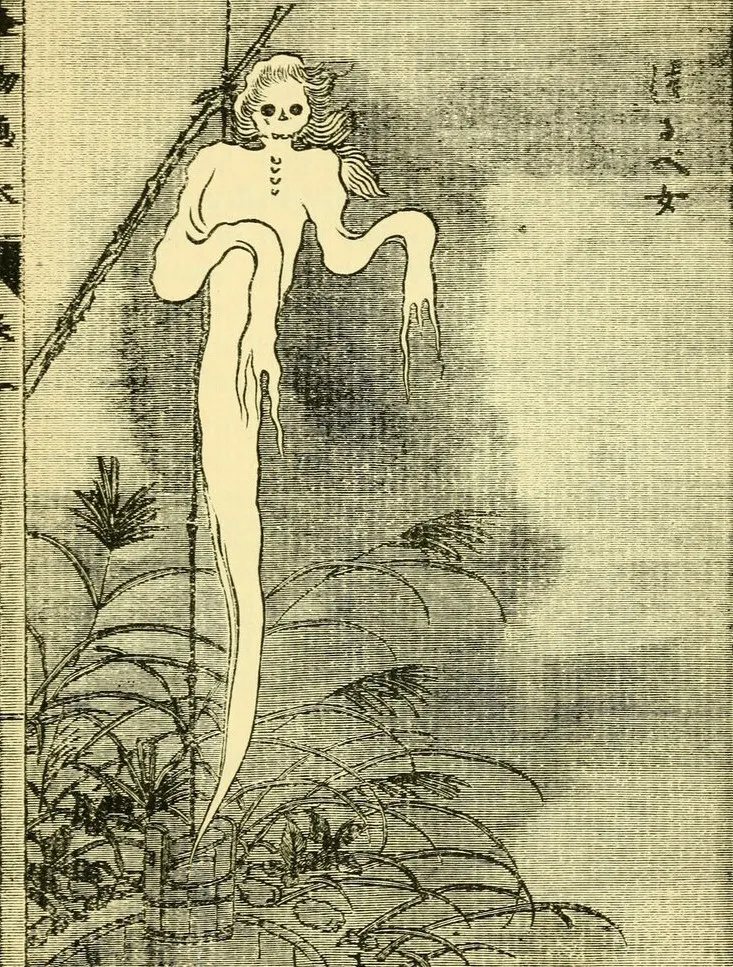
Well & water bogie spirit c.1899
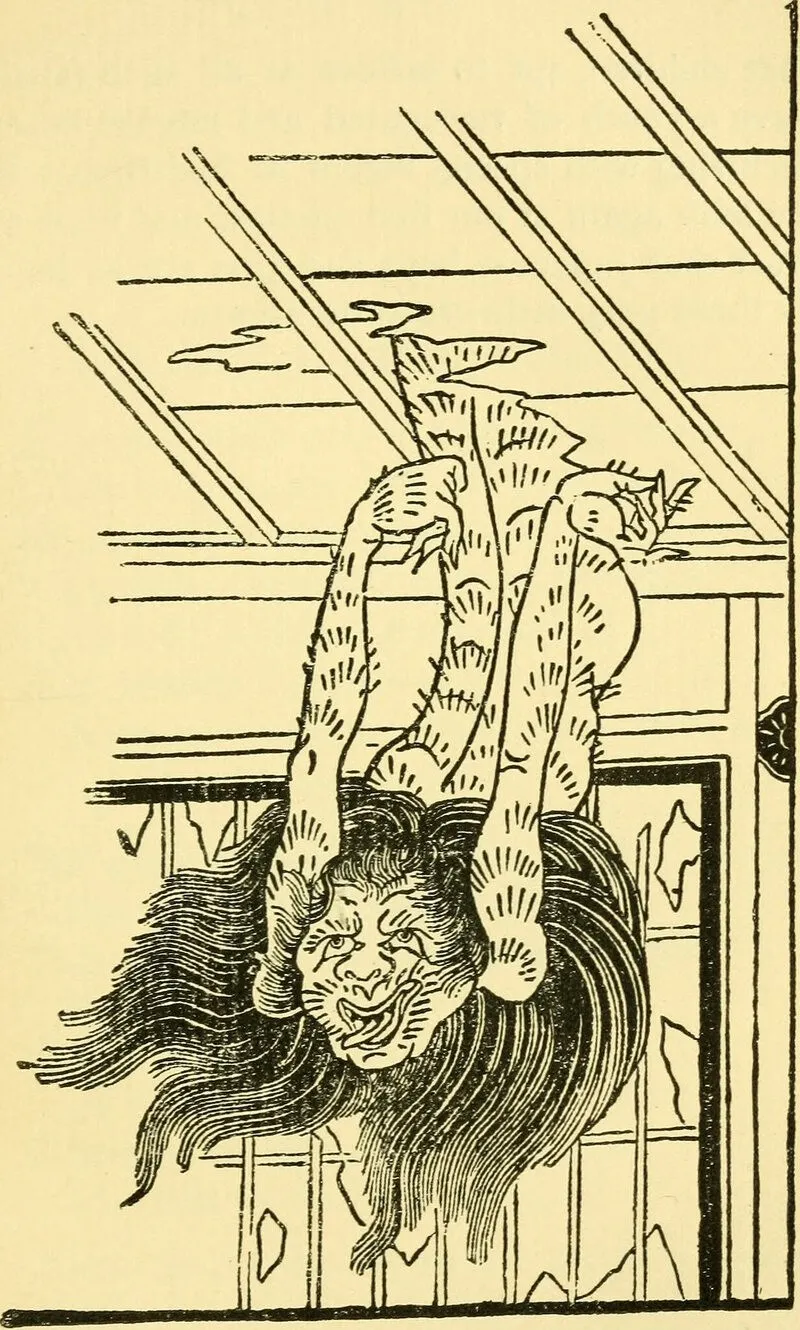
Spirit on the ceiling c.1899

The Basis for Samara Morgan and The Ring

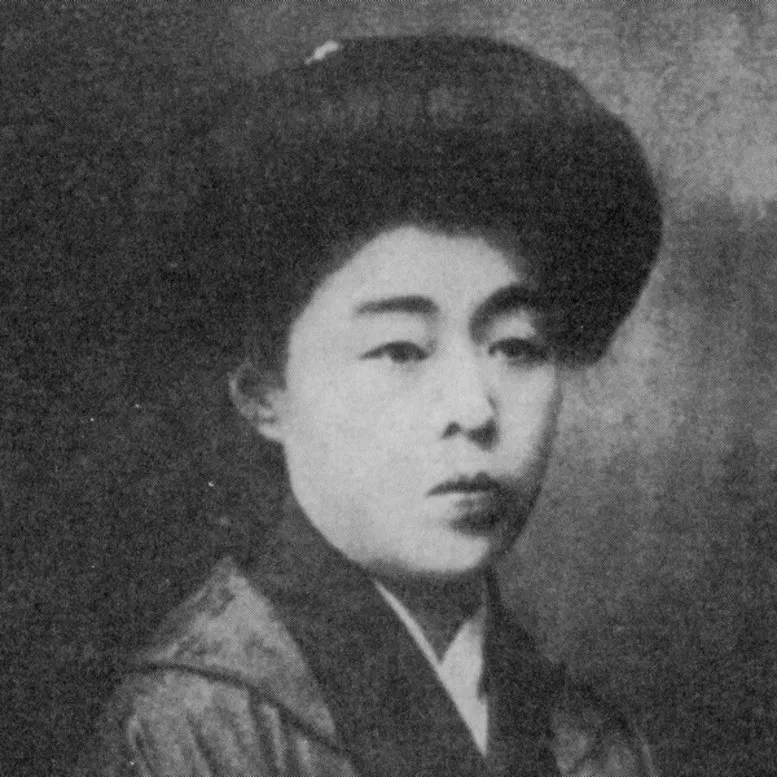
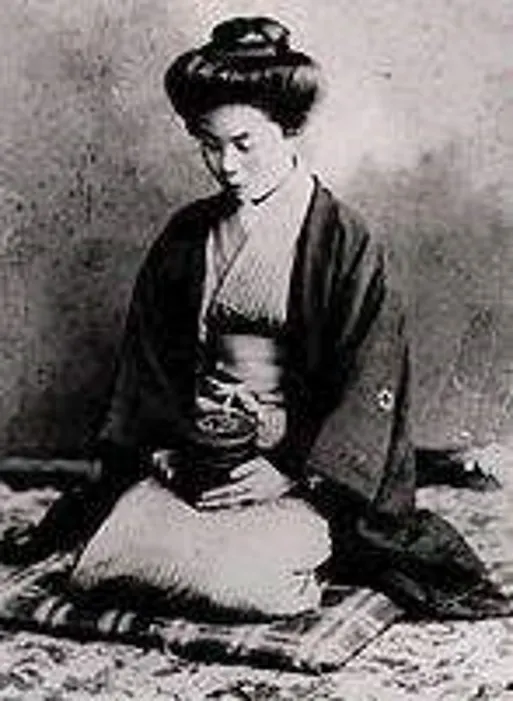
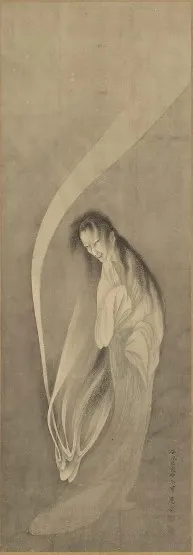
The yurei themselves are commonly pictured in white burial garments, the hems frayed and stained with water, long black hair concealing the face. Among them, the onryo is driven by a particular hunger for vengeance. The character of Sadako Yamamura, known to Western audiences as Samara Morgan in the Ring films, draws on real early-twentieth-century psychics. One was Sadako Takahashi, studied by psychologist Tomokichi Fukurai for her claimed ability to project images onto film through thought alone. Another was Chizuko Mifune, who took her own life at twenty-four by poison and inspired the fictional mother of Sadako.

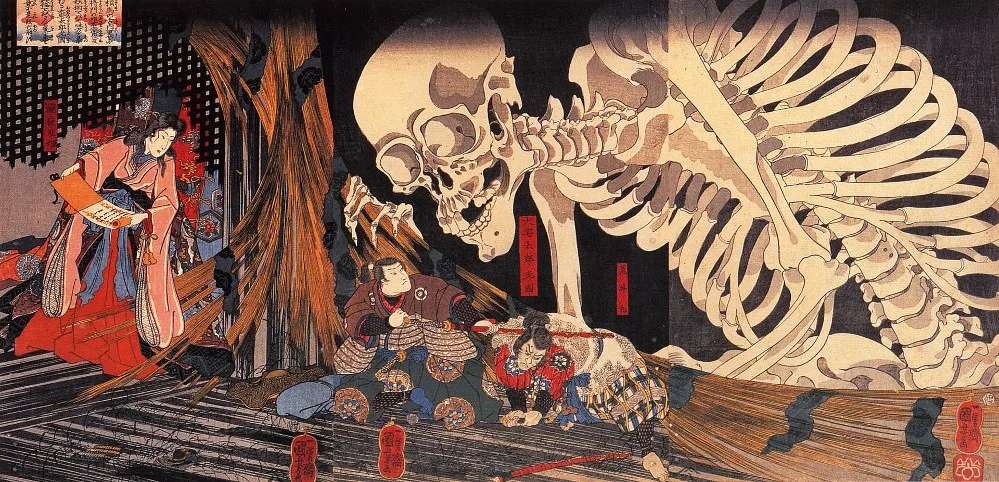
Not all of Japan’s monsters are human in origin. The Gashadokuro is a colossal skeleton formed from the bones of those who died in battle. With bulging yellow or green eyes, it roams after midnight, sometimes announcing itself with the grinding of teeth, sometimes moving in silence as it hunts. Because it is made of bone, it cannot be destroyed by ordinary means. Only Shinto charms can ward it off, and only the release of its lingering rage will cause the bones to collapse and free the trapped spirits.

Sadako Takahashi c.1886
Chizuko Mifune (1886-1911)

Hitobashira: The Human Pillars Beneath the Waters

Another root of Japan’s restless dead lies in the old custom of Hitobashira, the “human pillars” offered to rivers, bridges, and certain deities. The practice was once widespread enough that, as the historian and art scholar Noritake Tsuda observed in his 1918 essay “Human Sacrifices in Japan,” scarcely any elderly Japanese of his time had not heard some tale of Hitomi-goku or Hitobashira.

One of the earliest records appears in the Nihon Shoki. In the eleventh year of Emperor Nintoku’s reign (around 323 A.D.), the Kitakawa and Mamuta rivers flooded beyond the power of the people to contain them. The emperor dreamed that two persons—Kowakubi of Musashi and Koromono-ko of Kawachi—must be given to the river deities. Kowakubi was cast into the torrent with a prayer; the waters are said to have subsided. Koromono-ko escaped.

Similar stories clung to the building of bridges. A fifteenth-century diary recounts the Nagara-no Hitobashira: a woman carrying a child on her back was seized while passing the Nagara River and buried alive at the site of a great bridge then under construction. The structure stood, but the sacrifice was remembered.

Not all offerings were made to water. In the eleventh-century Konjaku Monogatari, two deities of Mimasaku Province—one a monkey called Chusan, the other a serpent called Koya—received an annual virgin drawn from the local people. As late as 1895, a traveler witnessed a related rite known as Oto in a village in Harima. Villagers still spoke of an eight-eyed weasel that had once lived in a bamboo thicket behind the Tenman-gu shrine; each year a boy and a girl were said to have been offered to quiet its malice. Elsewhere the custom survived only in symbolic form. At Sakato-no shrine in Kazusa, a parishioner chosen by lot was led to a chopping block while another performed a mime of execution. At the Juzo shrine in Noto, a chest holding “sacred water,” draped with clothing and a rosary, was carried to the shrine at midnight—an offering whose shape still recalled the older sacrifice.

Tsuda noted that traditions of this kind were most numerous when connected with water deities, then with monkey-like beings. Large public works, especially those involving rivers or bridges, frequently claimed lives during construction; over time, those deaths could be retold as deliberate offerings. The stories themselves multiplied most freely during the Tokugawa period, long after any official practice had ended, yet they continued to mark certain places as sites where a life had been given so that others might stand. In such places, it is said, the ground still listens for the footsteps of those who were not meant to leave.

UTAGAWA KUNIYOSHI (1797–1861), EDO PERIOD, 19TH CENTURY | MITSUKUNI DEFYING THE SKELETON SPECTRE CONJURED UP BY PRINCESS TAKIYASHA

In Japan, the dead are not always gone. Some remain because the circumstances of their death were unfinished; others because the living continue to remember—or fail to remember—them. The lanterns still burn, but the shadows between them have never entirely disappeared.