Leap Castle: The Elemental and the Horrors Within Ireland’s Haunted Fortress
Rising above the countryside of County Offaly, Ireland, Leap Castle has endured centuries of bloodshed, family rivalries, imprisonment, and unexplained occurrences. Its ancient walls have witnessed the ruthless ambitions of the O’Carroll clan, the discovery of a hidden chamber filled with human remains, and the destruction of the castle during the Irish Civil War. Yet among its many reported hauntings, none has inspired quite as much dread as the entity known as the Elemental—a grotesque, gray apparition said to possess a foul stench and a presence that leaves witnesses physically ill.

Some believe the creature predates the castle itself, a remnant of ancient pagan rituals bound to the site long before medieval stone walls rose above the surrounding landscape. Others suspect it may be the restless spirit of a leper who died within the fortress. Whatever its origin, accounts of the Elemental stretch across generations, from the chilling testimony of Mildred Darby in the early twentieth century to more recent reports of strange mists, disembodied presences, and unexplained disturbances during restoration work. And the Elemental is far from the only apparition said to haunt Leap Castle. Ghostly children, a murdered priest, a woman in red, and shadowy figures in the abandoned Priest’s House have all contributed to the fortress’s enduring reputation as one of Ireland’s most disturbing supernatural landmarks.

The Origins of Leap Castle and Its Dark Reputation
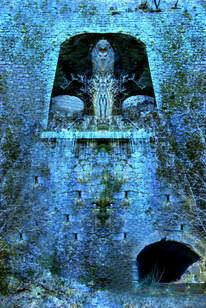
Leap Castle, known in Irish Gaelic as Caisleán Léim Uí Bhánáin, stands in County Offaly, Ireland. Its exact origins remain uncertain, although the castle is generally believed to have been built in the early sixteenth century by the O’Bannon clan. Archaeological evidence and local tradition suggest that an earlier stone structure once occupied the site. The area may have been inhabited since the Iron Age, around 500 B.C., and possibly as far back as the Neolithic period.
One theory holds that the Druids once used the location as a sacred site. According to this tradition, they left behind an elemental spirit to act as a sentinel, guarding a place whose significance had long since faded from memory. Whether the entity originated in ancient ritual or later folklore is impossible to establish from the accounts available.
Another legend attributes the Elemental’s presence to Gerald Fitzgerald, Earl of Kildare, who was reputed to practice magic. According to the story, Fitzgerald attempted to seize Leap Castle and summoned the entity in an effort to destroy the fortress by fire.
The castle later became a principal stronghold of the O’Carroll clan, whose power depended partly on controlling a strategic passage through the Slieve Bloom Mountains. Leap was considered exceptionally well fortified. The O’Carrolls, however, acquired a reputation for ruthless ambition, pursuing dominance through violence and frequently turning against one another.
Their bloody family history gave rise to another explanation for the castle’s supernatural reputation. Some believe the Elemental is not an ancient spirit at all, but the ghost of an O’Carroll who suffered from leprosy and died within the castle. This theory would explain the creature’s allegedly decomposing features and the unbearable stench reported during its appearances.
The O’Carrolls remained at Leap until 1642, when English soldier John Darby, associated with Cromwellian forces, took possession of the property. The Darby family occupied the castle until 1922, inheriting a fortress whose reputation for violence and unexplained activity was already firmly established.
The Discovery Beneath the Castle
In the late nineteenth century, work at Leap Castle brought long-hidden features of the fortress to light. These discoveries included ancient stairways, concealed rooms, extensive dungeons, and a chamber believed to have served as an oubliette—a place where prisoners could be confined and left to die.
A newspaper account published in the Democrat and Chronicle in 1897, under the title Discoveries in Leap Castle, described several remarkable finds.
“A series of interesting ‘finds’ just discovered in the historic Leap castle are described as a first, an 11th century stone spiral staircase springing from the first floor level and terminating at the summit of the great tower, 100 feet high. The finely cut stone steps are laid with mathematical accuracy and are large, like the passage itself. The O’Carrolls, princes of Ely, whose chief stronghold this castle was, were all big men, in fact, a race of giants, as the few relics of them extant attest.
The second find is an entrance to the guardroom cut out of the rock, and which was up to the present believed to be a mass of solid masonry. Here numerous bones, coins of the reign of Edward the Confessor (1005-1066 A.D.) and other relics were found. Human bones in large quantities, flints and spear heads were also found in the extensive range of dungeons, which have been brought to light beneath the castle, these curious prison-houses being rock -hewn and their existence having been previously unknown to the owner of the castle and the lord of the soul, Jonathan C. Darby.
The present owner has put into a complete state of preservation the ancient chapel, an apartment twenty-five feet square and high, which is on top of the tower, and here has been discovered a very large and fine early English window, which from its great elevation commands a view embracing eight counties. A little below this is a remarkable room, which none of the servants will enter after nightfall. It was a state bedroom of one of the princess of Ely, who was murdered six centuries ago by her lord, and the solid oak door retains the bloodstains of the royal victim. This part of the building is reputed to be haunted and Mr. and Mrs. Darby who do not believe in ghosts, admit that they cannot account for the extraordinary noises that occasionally come from the death chamber of the murdered princess, and which make it nearly impossible for them to retain their female servants in their employment. The manifestations are reputed to take the form of shrieks, which resound and reverberate through the building, and set all the dogs in the kennels whining and barking.”

The discovery of the dungeons and human remains deepened the castle’s grim reputation. Later accounts refer to approximately 150 bodies recovered from the oubliette. The number and circumstances of the deaths have become part of the castle’s haunting legend, although the precise history of the remains requires careful distinction from the supernatural stories attached to them.
The discovery also provided a possible explanation for the disturbing events that followed. Mildred Darby, who had married into the family in 1889, became associated with some of the best-known accounts of the Elemental.
Mildred Darby and the Elemental
Mildred Darby was interested in the occult and spiritualism and reportedly conducted séances at Leap Castle. She also wrote Gothic fiction, sometimes publishing under the name Andrew Merry. Some accounts suggest that her attempts to communicate with the dead awakened an entity that had long remained dormant. Others speculate that the discovery of the oubliette, with its grim collection of human remains, coincided with the beginning of her encounters.
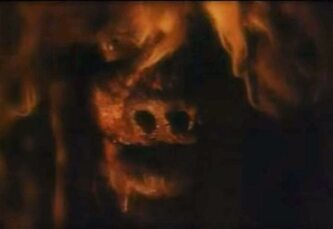
Whatever the cause, Darby described a creature unlike the familiar ghosts of folklore. Rather than appearing as a transparent human figure, it seemed part human and part animal, with a grotesque face, coarse hair, dark hollows where its eyes should have been, and a stench so foul that witnesses reportedly became nauseated.
One of the most famous descriptions appeared in The Occult Review around 1908 in an article titled Kilman Castle, The House of Horror. The account attributed to Darby described a terrifying encounter:
“Suddenly, two hands were laid on my shoulders. I turned round sharply and saw, as clearly as I see you now-a grey ‘Thing’, standing a couple of feet from me, with it’s bent arms raised as if it were cursing me. I cannot describe in words how utterly awful the ‘Thing’ was, it’s very undefinableness rendering the horrible shadow more gruesome. Human in shape, a little shorter than I am, I could just make out the shape of big black holes like great eyes and sharp features, but the whole figure-head, face, hands and all-was grey-unclean, blueish grey, something of the color and appearance of common cotton wool. But, oh! so sinister, repulsive and devilish. My friends who are clever about occult things say it is what they call an “Elemental”.

A further description emphasized the creature’s disturbing physical appearance and the sensation of decay that accompanied it:
“The thing was about the size of a sheep, thin, gaunt and shadowy in parts. It’s face was human, or to be more accurate, inhuman, in it’s vileness, with large holes of blackness for eyes, loose slobbery lips, and a thick saliva-dripping jaw, sloping back suddenly into its neck! Nose it had none, only spreading, cancerous cavities, the whole face being a uniform tint of grey. This too, was the color of the dark coarse hair covering its head, neck and body. It’s forearms were thickly coated with the same hair, so were its paws, large, loose and hand-shaped; and it sat on it’s hind legs, one hand or paw was raised, and a claw-like finger was extended ready to scratch the paint. It’s lustreless eyes, which seemed half decomposed, and looked incredibly foul, stared into mine, and the horrible smell which had before offended my nostrils, only a hundred times intensified, came up to my face, filling me with a deadly nausea. I noticed the lower half of the creature was indefinite and seemed semi-transparent-at least, I could see the framework of the door that led into the gallery through its body”.

Another witness later wrote to The Occult Review in response to the article, describing a similar encounter at the castle:
“I saw your eyes fixed upon something above our heads, and the next minute my own eyes were filled by the sight of a Thing in the gallery looking down at us. There was plenty of light from the lamps in the hall and the one above on the wall at the corner of the gallery, for every one of us to see quite plainly the grey-colored figure about the height of a small grown-up person looking down at us. I wish I thought I could ever forget the sight of that grey figure with dark spots like holes in its head instead of eyes, standing with grey arms folded on the gallery railing looking down at us. Then just as he put foot on the gallery, the Thing that he saw there, that we were watching, suddenly faded out of sight. The Thing did not move, only became less and less visible until it vanished.”
These descriptions established the Elemental as something distinctly different from the castle’s other reported spirits. It was not simply a ghostly figure from the past, but an apparently inhuman presence that witnesses associated with physical revulsion, dread, and the unmistakable smell of decay.
The Elemental’s Final Appearance in 1915
Mildred Darby later described what she considered the Elemental’s final appearance, which reportedly occurred on November 25, 1915. Her account involved two servants who had invited two soldiers from the barracks at Birr, about six miles away, to visit the castle. When Darby’s husband returned earlier than expected, the visitors were hidden in a less-used section of the property known as the Priest’s House, which dates back to 1571.
At approximately 7:15 p.m., Mildred and her husband went upstairs to dress for dinner. A sudden chorus of terrified cries from the hall drew them out of their rooms. Darby’s account described what happened next:
“The last appearance of the Elemental was on November 25, 1915. On that date two of our servants knowing the “master” would be late and that I was driving that afternoon had invited “friends”, two soldiers from the Barracks at Birr, distant the other side 6 miles. They came rather late and my husband came home early so the visitors had to be kept out of his sight in the lower regions of one of the wings (the Priests House), and were unable to be shown the center tower – the very lofty hall. At 7:15 my husband and I went up to dress for dinner, my room is in extremity of the house from the kitchen, his dressing room next door to me. Whilst dressing I was startled by a loud yell of terror stricken male and female voices coming apparently from the hall – and ran out to see the cause. My husband was out ahead of me, at his heels I passed through the corridor of one wing and onto the gallery wing, rounds two sides of hall. Two lamps on the gallery, two more in hall below. On the gallery leaning with “hands” resting on its rail I saw the Thing – the Elemental and smelt it only too well.
At the same moment my husband pulled up sharply about 10 feet from the Thing, and half turning let fly a volley of abuse at me, ending up ‘Dressing up a thing like that to try and make a fool of me. And now you’ll say I’ve seen something and I have not seen anything and there is nothing to see, or ever was’. This last speech without a pause, begun waving one hand at the Thing, and ended up by stalking back to his dressing room still abusing me for trying to give him a fright. As he was speaking the Elemental grew fainter and fainter in its outlines until it disappeared. By the sounds from my husband’s room I judged he was employed as I was myself, in preparing an empty spot for our coming dinner. He never made any inquiry as to the yell that called us both out, and from that day to this has not mentioned the incident to me. I heard from our servants that when we went to dress for dinner they had brought their friends just to show them the hall, when all four has suddenly seen and smelt the Elemental looking down at them from the gallery. We all got such a turn, we couldn’t help letting out a bawl, then fled to the servants quarters where all 4 were very sick. The two maids had letters necessitating their going home next day – and they did not return”.

According to Darby, the apparition faded before the witnesses could do anything but stare. Her husband, though he apparently saw the figure himself, refused to acknowledge the encounter afterward. The servants and their guests reportedly suffered such intense nausea and distress that the two maids left the following day and never returned.
Whether the account reflects a genuine unexplained experience, a story shaped by the castle’s existing reputation, or some other event, it remains one of the most vivid descriptions associated with Leap Castle.
Fire, Exile, and the End of the Darby Occupation
In 1922, during the Irish Civil War, Leap Castle was burned. The Darby family left for England for a short period before returning to Ireland and settling with relatives at Doory Hall in County Longford. The move was reportedly connected with a claim for compensation under the Compensation to Property Act of 1923.
Mildred Darby later said that she had lost at least two drawers of writings in the fire, including work she had hoped to publish. She never again published under the name Andrew Merry and died on January 5, 1932.
The blaze left much of the castle in ruins, including the ancient chapel. Yet stories of hauntings had circulated long before the fire, and the destruction of the building did little to diminish its reputation.
One of the oldest and most persistent legends concerns an O’Carroll who allegedly murdered his own brother, a priest, while the latter was celebrating Mass. The killing was said to have been motivated by a struggle for control of the castle. In later accounts, the murdered priest appears near the stairwell, while lights are reportedly seen shining through the ruined chapel windows after dark. Some visitors have also associated the apparition with the smell of burning rubber.
Another figure linked to the castle is the so-called Red Lady, a woman believed to have met a violent end at the hands of one of the O’Carroll men. According to one version of the story, the woman became pregnant after being taken by a member of the family. When the child was born, the man allegedly killed it with a blade. In despair, the mother seized the knife and took her own life.
The woman is said to wander the grounds wearing a long red dress, her brown hair streaming behind her and a dagger in her hand. In some accounts, she runs as though still fleeing the person who attacked her. It is possible that different versions of the story have merged over time, but the Red Lady remains one of Leap Castle’s most enduring spectral figures.
Mildred Darby also recounted an unsettling experience involving a woman who appeared to fall near the back staircase:
“One night I was sitting talking with my governess, I got up, said good-night, and opened the door, which was on the top of the back staircase. As I did so, I heard someone (a woman) come slowly upstairs, walk past us to a window at the end of the landing, and then with a shriek fall heavily. As she passed it was bitterly cold, and I drew back into the room, but did not say anything, as it might frighten the governess.”

Darby described other strange events in the Priest’s House, including the sensation of an enormous weight pressing down on sleepers and the sound of heavy breathing or snoring. She also reported seeing a monk wearing a tonsure and cowl walk in through one window and out through another.
Mildred Darby also witnessed ghostly events. She said,
“There is something heavy that lies on people’s beds, and snores. They feel the weight of a great body pressing against them, in a room in the Priest’s House. A monk, with a tonsure and cowl, walks in at one window and out another, in the Priest’s House.”
A similar creature appears in True Ghost Stories, a collection published in the 1930s by the Marchioness Townshend of Raynham and Maude Ffoulkes. The story does not name the castle, describing it only as an old property in southern Ireland. Its similarities to the Leap Castle Elemental have led some to speculate that the location was deliberately concealed.
The tale was reportedly told to the Reverend Archdeacon St. John D. Seymour and vouched for by Reginald Span, vicar of the Anglican Church in Arizona. According to the account, an American family rented a castle despite local rumors of strange occurrences.
One evening, Mrs. A. waited for her husband to return from Dublin when she heard a door slam and unusual footsteps in the corridor. She went to investigate and encountered a creature with a human face and an animal-like body.
“… the stillness was shattered by the loud banging of a door in the corridor followed by stealthy footsteps creeping and crawling about in a very peculiar manner. Mrs. A., neither nervous nor imaginative, opened her bedroom door and hurried outside.
At first she saw nothing; afterwards, as she stood holding her lighted candle above her head to get a better view, she noticed an extraordinary figure shambling in the direction of the staircase. Before she had time to wonder who on all the earth was roaming around, the creature turned and looked at her, and Mrs. A. saw what appeared to be a hideous human face on the body of a huge ape. The revolting creature stared at the frightened woman for a few seconds—and then vanished.”
Mrs. A. fled to her room, where her daughter suggested that she might have experienced a waking nightmare. She said nothing to her husband when he returned. A few nights later, however, he reportedly encountered the creature himself.
“All at once he heard a queer kind of laugh, and looking up at the landing, he saw an ungainly figure learning over the banisters. The obscene face, of a leprous whiteness, was that of a clean-shaven, youngish man and its expression was not only evil—but horrible. As the creature looked at Mr. A., its body positively shook with laughter—and Mr. A. noticed that the hands and arms resting on the banister rails, covered with thick reddish-brown hair, were those of an ape.”
Mr. A. rushed toward the staircase, while the creature reportedly laughed at him. His family came out of their rooms to discover what had happened. Only then did Mrs. A. reveal that she, too, had seen the apparition.
The family searched the castle the following day but found no explanation. For a time, the incidents subsided, although strange sounds, faint cries, footsteps, and banging doors reportedly continued during the early hours.
The final encounter occurred when the family’s daughter was arranging flowers. She felt hands on her shoulders and turned to face the same creature her parents had described.
“The daylight showed the creature to be neither human nor animal—it was covered with hair like a gorilla, it stood over six feet high, and its appearance was so repulsive that Miss A., overcome with disgust called loudly for help. But just as her friend came to the rescue, the Ape Man vanished, although not before the other girl had caught a glimpse of the horror it represented.”
The family eventually decided to return to America. The story’s resemblance to accounts of the Elemental is striking, particularly its combination of human and animal features, its repulsive appearance, and its habit of vanishing before witnesses could investigate. Nevertheless, because the castle was never identified, a direct connection to Leap remains speculative.
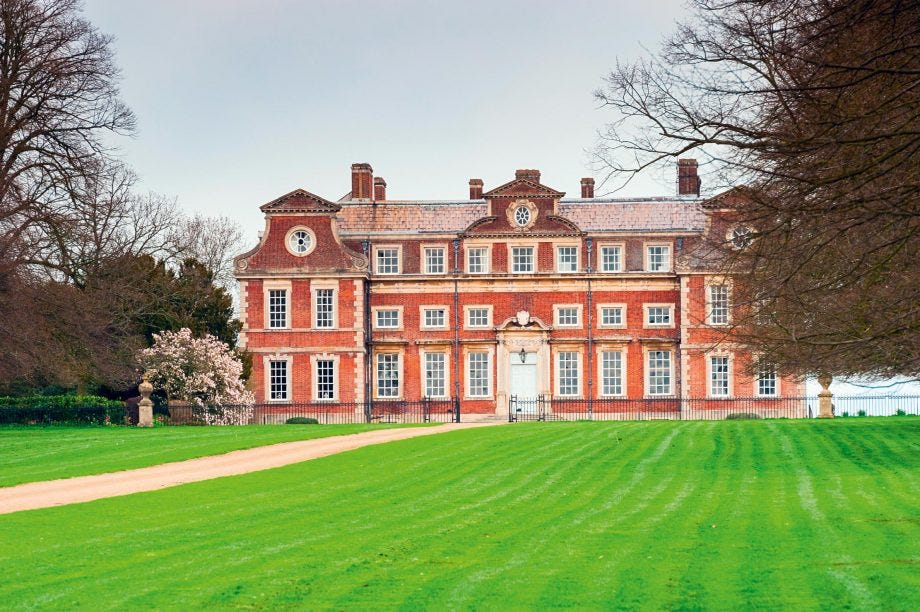
A Tale of Two Haunted Castles: The Brown Lady of Raynham Hall
The same collection also discusses the Brown Lady of Raynham Hall, one of England’s best-known ghost stories. Although the apparition belongs to a different castle and a separate tradition, its history offers a useful comparison with the long-standing legends surrounding Leap Castle.
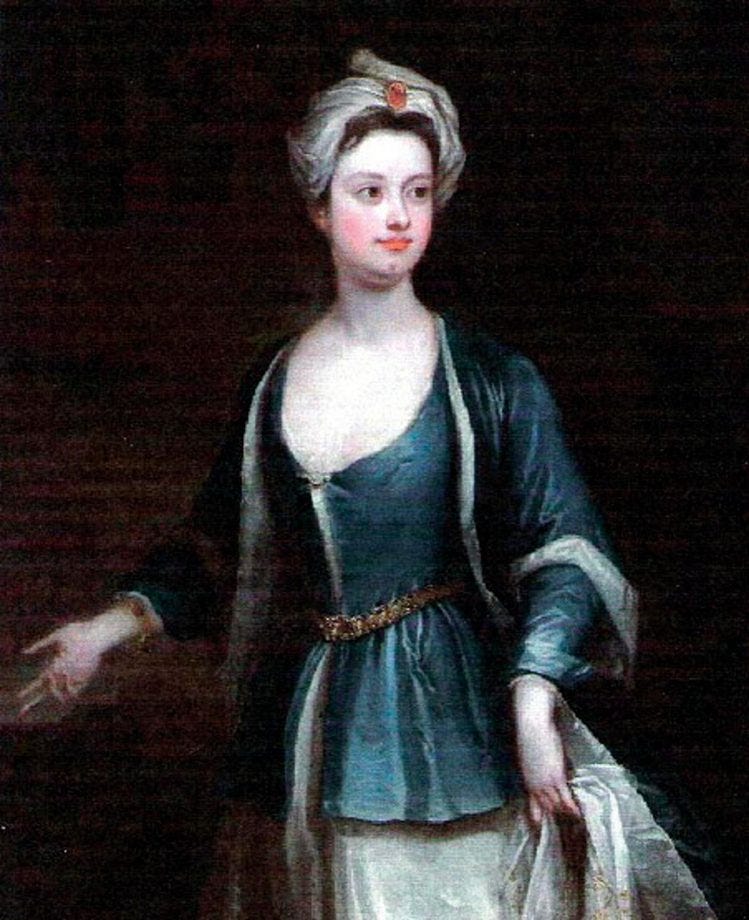
The Brown Lady of Raynham Hall is the reputed ghost of Lady Dorothy Walpole (1686–1726), the sister of Britain’s first Prime Minister, Sir Robert Walpole. She was the second wife of Charles Townshend, 2nd Viscount Townshend. Charles and Dorothy married in 1713, but there were rumors that the marriage wasn’t a happy one. Charles was a man with a violent temper, and he was jealous. Legend claims she was locked in Raynham Hall in Norfolk after an adulterous affair with Lord Wharton, where she died under mysterious circumstances, often cited as smallpox or starvation. Some accounts suggest she was entrapped by the Countess of Wharton rather than her husband.
The Brown Lady was first reportedly seen during Christmas festivities in 1835, when Colonel Loftus and another guest, Mr. Hawkins, encountered a woman wearing a brown dress. Loftus later described seeing her face illuminated, with empty sockets where her eyes should have been. Several servants reportedly left after the encounter.
Years later, Captain Frederick Marryat deliberately stayed in the room where the apparition was said to appear. He suspected that smugglers might have encouraged the haunting story to keep people away from the area. His daughter, Florence Marryat, recounted his experience in 1891.
“…he took possession of the room in which the portrait of the apparition hung, and in which she had been often seen, and slept each night with a loaded revolver under his pillow. For two days, however, he saw nothing, and the third was to be the limit of his stay. On the third night, however, two young men (nephews of the baronet), knocked at his door as he was undressing to go to bed, and asked him to step over to their room (which was at the other end of the corridor), and give them his opinion on a new gun just arrived from London. My father was in his shirt and trousers, but as the hour was late, and everybody had retired to rest except themselves, he prepared to accompany them as he was. As they were leaving the room, he caught up his revolver, “in case you meet the Brown Lady,” he said, laughing. When the inspection of the gun was over, the young men in the same spirit declared they would accompany my father back again, “in case you meet the Brown Lady,” they repeated, laughing also. The three gentlemen therefore returned in company.
The corridor was long and dark, for the lights had been extinguished, but as they reached the middle of it, they saw the glimmer of a lamp coming towards them from the other end. “One of the ladies going to visit the nurseries,” whispered the young Townshends to my father. Now the bedroom doors in that corridor faced each other, and each room had a double door with a space between, as is the case in many old-fashioned houses. My father, as I have said, was in shirt and trousers only, and his native modesty made him feel uncomfortable, so he slipped within one of the outer doors (his friends following his example), in order to conceal himself until the lady should have passed by.
I have heard him describe how he watched her approaching nearer and nearer, through the chink of the door, until, as she was close enough for him to distinguish the colors and style of her costume, he recognized the figure as the facsimile of the portrait of “The Brown Lady”. He had his finger on the trigger of his revolver, and was about to demand it to stop and give the reason for its presence there, when the figure halted of its own accord before the door behind which he stood, and holding the lighted lamp she carried to her features, grinned in a malicious and diabolical manner at him. This act so infuriated my father, who was anything but lamb-like in disposition, that he sprang into the corridor with a bound, and discharged the revolver right in her face. The figure instantly disappeared – the figure at which for several minutes three men had been looking together – and the bullet passed through the outer door of the room on the opposite side of the corridor, and lodged in the panel of the inner one. My father never attempted again to interfere with ‘The Brown Lady of Raynham’”
According to the account, Lady Townshend later reported another sighting in 1926, when her son George and a friend saw the figure on the staircase. The apparition was identified with Lady Dorothy Walpole, whose portrait hung in a room associated with the haunting.
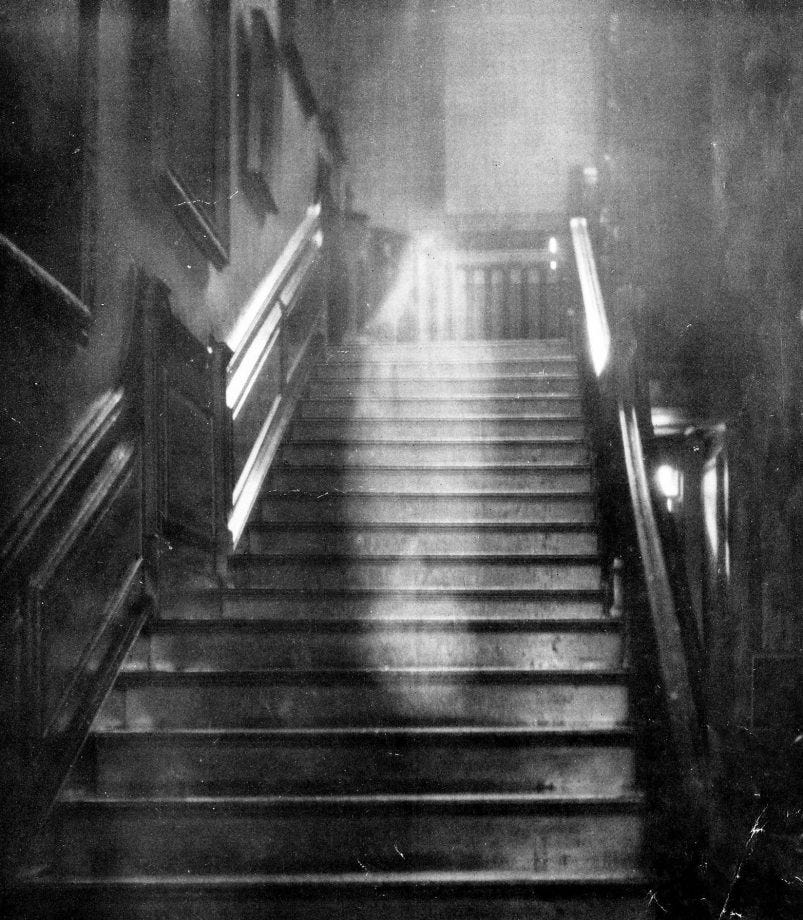
The most famous episode occurred on September 19, 1936, when photographer Captain Hubert C. Provand and his assistant, Indre Shira, visited Raynham Hall while working on an article for Country Life magazine. As they prepared to photograph the main staircase, they reportedly noticed a vaporous figure resembling a woman descending the steps. They took a photograph, which appeared in the magazine’s December 26, 1936 issue and was later reprinted by Life magazine on January 4, 1937.
The resulting image became one of the most famous purported ghost photographs ever published. Like the stories surrounding Leap Castle, the Brown Lady legend demonstrates how a historic building’s atmosphere, family history, and repeated reports can become inseparable from its supernatural reputation.
The Castle After the Darbys: Fifty Years of Silence
After the Darby family departed, Leap Castle remained unoccupied for approximately fifty years. Its empty rooms and ruined sections became the setting for further reports of strange sensations and unexplained activity.
Peter Gerrard owned the property for a short time before Peter Bartlett acquired it. Bartlett’s mother had been a friend of Cicely O’Carroll-Darby and had once been invited to a dance at the castle. During her stay, she reportedly slept poorly, repeatedly sensing that someone—or something—was hovering near the foot of her bed.
In 1974, Peter Bartlett, an Australian historian whose mother was descended from the O’Bannons, purchased the castle and began restoration work. He died in 1989 before completing the project. Sean Ryan bought the property in 1991 and continued the restoration, eventually opening part of the castle to visitors.
The restoration years brought fresh stories of unexplained disturbances. Bartlett reportedly spoke of substantial poltergeist activity during his time at the castle, although he did not provide detailed accounts. Ryan described tools being moved to distant corners of a room when he turned his back. A carpenter working on the property reportedly left suddenly and never returned, not explain.
Ryan also described two accidents during restoration. On one occasion, a ladder he was using was allegedly pushed away from the wall, forcing him to jump several stories and fracturing his knee. After work resumed, another accident left him with a broken ankle. Those who believe in the castle’s haunting interpret these events as possible attempts to drive the living away. Others may view them as accidents occurring during the difficult work of restoring an old, damaged building.
Modern Encounters with the Elemental
The Elemental’s reputation did not end with the Darby family. Visitors and investigators have continued to describe unsettling experiences at Leap Castle.
These are descriptions of other encounters at Leap Castle:
June 18, 2002
“I traveled to Leap Castle in order to make a show for a local TV network, and this was my first time in the notorious castle I had heard so much about. So the show went well, but I wanted to try the UV on the camcorder whilst still shooting. I had sensed something down the old access to the battlements earlier, and never went down. I climbed the stairs with the camcorder in front; the light from the UV allowed me to see about 6ft. ahead and no more, so I climbed slowly.
I opened the gothic-style door and made my way slowly down the narrow passage; about 10 feet in, I thought I saw something move, and I lifted my head. I could feel something was wrong, but I had no idea what. This time, with the camera dropped, I thought I saw a glow come from around the corner, and then it went back in. I stood and studied this for a while, and thought it might be a side effect of the UV, which can be common. A few steps more and my body was weakening fast; it was a strange sensation. Suddenly, this mass of white-like mist raced around the corner like a bull; even the rubbish on the floor scattered as it approached at speed. The passage was tight, and I turned to my left to try and get out, but it was too late; I felt the pain as if something had just pierced under my right rib cage and went all the way through to the back.
This startled me a little, and we proceeded to arrange shooting in the cellars. The audio refused to tape again in the cellars, and I felt really odd; I was sweating heavily and was becoming very weak and drowned in dread. Right after the incident in the tunnel, it felt as if a hole in my chest had been punctured on a spiritual level, and my life was seeping into the stones. To describe it and let the reader understand, they would have had to experience a large blood loss sometime in their lives. As they felt the blood drain, this weakness would become prominent; in other words, they were experiencing the onset of death. I was dying.”
June, 2006
“I looked into the darkness of a corridor that exited the spiral stairway. I became aware of the smell of sulphur. It was as if boxes and boxes of matches had suddenly been lit at once. I looked at my friend who had taken me to visit Leap Castle. He could also smell the sulphur. I stared into the darkness of the corridor and had the impression that a beast like a bear or lion was staring back at me. The tension was rising like a ticking time bomb. My friend then closed the door and said, ‘To let sleeping dogs lie’. Meaning sometimes you just have to leave things alone. He was a friend of Sean Ryan, and I certainly did not want to disrespect either of them by stirring up the ‘Elemental’.”
The decision to close the door rather than investigate further reflects the caution often found in accounts of Leap Castle. For some visitors, the experience of the place is unsettling enough without attempting to provoke whatever may—or may not—be present.
The Lesser-Known Ghosts of Leap Castle
Although the Elemental receives much of the attention, Leap Castle is associated with several other apparitions. Some are said to appear repeatedly in particular parts of the building, while others are linked to individual tragedies from the castle’s past.
In the main hall, an elderly man has reportedly been seen sitting beside the fire. In the remains of the Priest’s House, witnesses describe a burly figure dressed like a peasant, struggling to push a heavy barrel up the back stairs near the servants’ quarters. When the man reaches the top, the barrel rolls backward, and both figure and barrel disappear.
A monk wearing a tonsure and cowl is also said to walk through one window of the Priest’s House and leave through another. Shadowy forms have reportedly wandered through the abandoned building, while guests and members of the Ryan family have described hearing chanting that abruptly stops when someone mentions it.
Emily and Charlotte: The Ghostly Children
Two young girls, known as Emily and Charlotte, are said to haunt the castle’s main hall and stairwell. Emily is described as approximately eleven or twelve years old, while Charlotte is believed to have been around six or seven. Their identities remain uncertain, although one tradition suggests that they lived at Leap during the seventeenth century and may have belonged to the final generation of the O’Carroll family or the earliest generation of the Darbys.
Emily reportedly died after falling from the castle’s southeastern battlements. Visitors outside the building have claimed to see a girl fall from the roof and vanish before reaching the ground. Members of the Ryan family have also reported hearing a child’s scream abruptly cut off.
Charlotte is said to have a badly deformed right leg, twisted almost backward and dragging behind her as she runs after the older girl. A woman believed to be a nanny or governess is sometimes seen accompanying the children.
Mildred Darby also described seeing a young girl in her bedroom one night:
“Another night I was sleeping with my little girl. I awoke, and saw a girl with long, fair hair standing at the fireplace, one hand at her side, the other on the chimney-piece. Thinking at first it was my little girl, I felt on the pillow to see if she were gone, but she was fast asleep. There was no fire or light of any kind in the room.”

The resemblance between Darby’s account and the later stories of Emily and Charlotte has encouraged speculation that the girl she saw was one of the castle’s child apparitions. However, the original account does not identify the figure by name.
The Murder Hole Room
Among the castle’s most disturbing locations is a room known as the Murder Hole Room, sometimes called the Muckle Hole Room. Its exact location is uncertain, and two possible sites have been suggested.
One theory places it in the South Wing, where a machicolation above the original entrance could have allowed defenders to attack intruders approaching the door. Another theory places it in the North Wing, beneath the oubliette. In this interpretation, the name may have become associated with the chamber where prisoners were abandoned or killed.
The room also features in a story about two O’Carroll brothers who allegedly fought over ownership of the castle. According to the legend, one brother murdered the other, and a bloodstain appeared on the floor despite repeated attempts to remove it.
Mildred Darby described a disturbing nighttime experience in an article titled Kilman Castle: The House of Horror:
“I put my hand out of bed, snapping my fingers to call her Nell, (a terrier). My hand was suddenly in the grasp of another hand, a soft, cool hand, at a temperature perceptibly below my own flesh. To say I was astonished would but mildly convey my feelings! After a few seconds of steady pressure the other hand let go, and almost simultaneously I heard a heavy sliding fall, like the collapse of a large body at the foot of the bed. Then in the absolute stillness of the room there sounded a deep human groan, and some half-articulated words, or to be accurate, prayers. The story goes that the stain on the floor is the blood of a man stabbed there by his brother. Two O’Carrolls quarreled over the ownership of the castle. The room had been disused for 50 years or more when we did it up. The stain has been planed off the boards several times, but it always comes again-creeps up from below in a few hours”.
The account combines a personal encounter with the older murder legend. Whether the alleged stain had a physical explanation or became part of the story through repeated retelling remains unclear. Nevertheless, the room’s association with fratricide and unexplained nighttime experiences has made it one of the most sinister locations in the castle’s folklore.
Today, Leap Castle remains a place where history and legend intertwine, its battered stone walls preserving memories of ancient rivalries, violent deaths, and encounters that defy easy explanation. Whether the Elemental is an ancient presence rooted in forgotten pagan beliefs, a manifestation of the castle’s brutal past, or a legend sustained by generations of uneasy witnesses, its story continues to cast a shadow over the fortress. The ghostly children, the murdered priest, the Red Lady, and the strange figures said to wander the ruined Priest’s House only deepen the mystery. Perhaps these tales are nothing more than echoes of a troubled history, given new life by the imagination. Yet for those who have walked Leap Castle’s shadowed corridors and reported an inexplicable chill, a foul odor, or the sensation of something watching from the darkness, one unsettling question remains: What if the most terrible secrets of Leap Castle were never truly laid to rest?