

The Condemnation of Memory: Hidden Portraits, Erased Faces and the Secrets Beneath Famous Paintings
Some faces were never meant to survive. Beneath the sober portrait of a Scottish nobleman, modern X-rays have revealed the ghostly outline of a queen whose likeness became too dangerous to display. Mary, Queen of Scots is only one of many figures who were painted over, scratched out or quietly erased from history. Their stories span from ancient Rome to Renaissance Florence, and from the studios of Vermeer and Picasso to the darkroom purges of Stalin’s Soviet Union.

The Condemnation of Memory
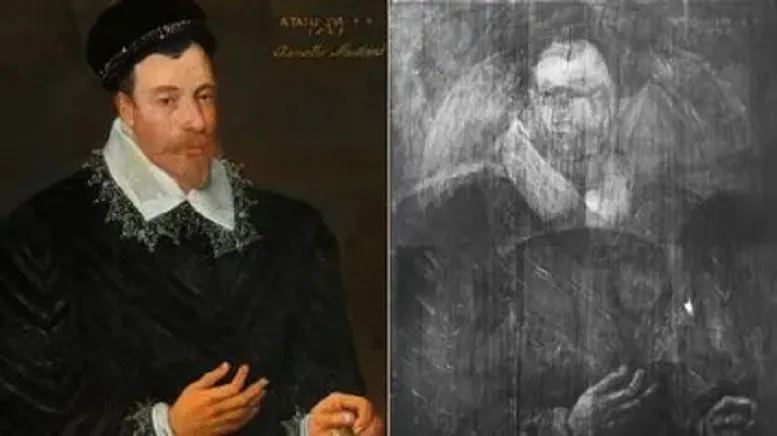
In 2017, researchers announced that beneath the portrait of a sixteenth-century gentleman in a black doublet lay the hidden image of a doomed queen: Mary, Queen of Scots.
The discovery began when Caroline Rae, a research fellow at the Courtauld Institute of Art in London, was studying a portrait of Sir John Maitland, 1st Lord Maitland of Thirlestane and a one-time Lord Chancellor of Scotland. The painting, completed in 1589 by Adrian Vanson, court painter to James VI of Scotland, usually hangs in a London gallery. A black-and-white X-ray revealed a different composition beneath the surface. Rae believed the figure was Mary Queen of Scots (1542–1587), and she supported this by comparing it with two miniatures of Mary by Nicholas Hilliard. In the hidden image, Mary’s head tilts to one side, her hand rests at her waist, and she wears a wired cap and a square-necked gown.
For reasons unknown, Vanson abandoned Mary’s portrait. He then reworked her gown into Sir John’s doublet, and her right hand became his.
A Queen’s Rise and Fall
Born Mary Stuart, she was the great-niece of King Henry VIII. Her father died when she was only six days old, and as his sole surviving legitimate child, she became Mary I of Scotland. While still a child, she was betrothed to Francis, the Dauphin of France, and the two married when she was fifteen. When the French king died in a jousting accident in 1559, Francis ascended the throne, and Mary became queen consort. Francis himself died the following year, and at eighteen, Mary returned to Scotland as a widow.
She later married her cousin Henry Stewart, Lord Darnley, and their son became James VI. Accusations that she had been involved in Darnley’s murder forced her to abdicate. Her cousin, Queen Elizabeth I, imprisoned her in 1568 and, after nearly two decades of captivity, sent her to the executioner in 1587. That was only two years before the date on the finished portrait.
Vanson was most likely working from earlier portraits, and he may have deliberately disguised Mary’s likeness. After her execution, displaying her image was a dangerous act.
The Cupid Behind the Girl
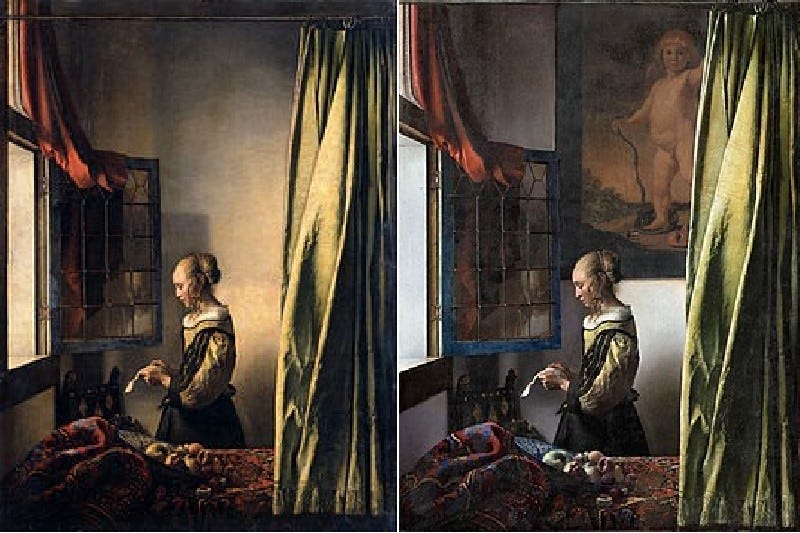
Mary’s portrait was not the first hidden image to surface. In 1979, researchers examining Johannes Vermeer’s (1632–1675) Girl Reading a Letter at an Open Window (c. 1657–59) found a picture within the picture. A naked Cupid had once hung on the wall of the background room. Vermeer had not painted it out. Analysis showed that someone else covered it several years after his death, probably in the late eighteenth century. Who did it, and why, remains unknown.
The Cupid mattered because it changed the painting’s meaning. With the god of love looming behind her, the girl is clearly reading a love letter. One theory is that a later owner found the figure unsuitable. Cupid, often depicted as a plump, naked, sometimes winged boy called a putto, was long associated with profane passion and illicit love. In time, the putto evolved into the baby angels we call cherubs, although in traditional Christian theology the cherubim rank among the highest beings in the angelic hierarchy.
The painting’s own history was just as turbulent. It was once misattributed to Pieter de Hooch, and only in the 1860s did scholars recognize it as a Vermeer. During the bombing of Dresden in World War II, it was sheltered with other treasures in a tunnel in Saxony, where the Soviet Red Army found it and carried it away. After Stalin died in 1953, Germany returned it in 1955 to the city where it had hung since Augustus III of Poland, Elector of Saxony, bought it in 1742. Decades later, conservators removed the overpainting and brought Cupid back into view.
Vermeer also painted Girl with a Pearl Earring (c. 1665), which inspired Tracy Chevalier’s 1999 novel and the 2003 film of the same name.
Damnatio Memoriae
Hiding a subject for political reasons is nothing new. The Latin phrase damnatio memoriae, the “condemnation of memory,” describes a practice that has recurred throughout history. The Roman Senate approved the destruction of images of disgraced emperors, whose faces were chiseled from statues and struck from coins.
In sixteenth-century Italy, Bernardo de’ Rossi (1458–1527), a bishop, commissioned a painting of the Madonna and Child after surviving an attempt on his life. He wished to appear in the picture himself, but after his death, his family erased him and painted in the infant St. John the Baptist instead.
Bianca Cappello: A Grand Duchess Erased
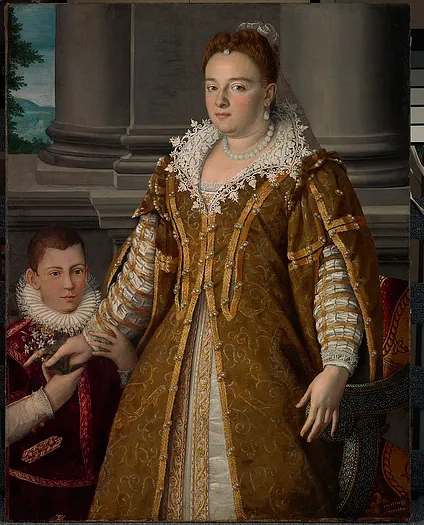
Mary Queen of Scots, Bishop de’ Rossi and Bianca Cappello all lived in turbulent times. Bianca became Grand Duchess consort of Tuscany by marrying Francesco I de’ Medici (1541–1587). In October 1587 she and her husband died within a day of each other. Some believed they were poisoned, while other historians blamed malaria.
Because Bianca was not considered a true member of the Medici family, her brother-in-law, Cardinal Ferdinando, refused to bury her in the family tombs. She is thought to lie in an unmarked mass grave beneath the church at Poggio a Caiano. Ferdinando not only consigned her to an anonymous grave but also had many of her portraits destroyed.
The suspicions never went away. In 2006, toxicology tests at the University of Florence found evidence of arsenic poisoning in Francesco’s remains. In 2010, researchers also detected the parasite that causes malaria, the very cause of death Ferdinando had announced. Bianca’s remains could not be tested because her burial site is still unknown.
The couple suffered symptoms consistent with arsenic poisoning for eleven days before they died. The long-standing belief was that Ferdinando murdered them, since Francesco and Bianca’s son, Don Antonio, threatened to displace him as heir to the grand duchy. Could Ferdinando have exploited his brother’s malaria, using a poison that mimicked its symptoms to dispatch Bianca as well? The question has never been settled.
Erased by the State
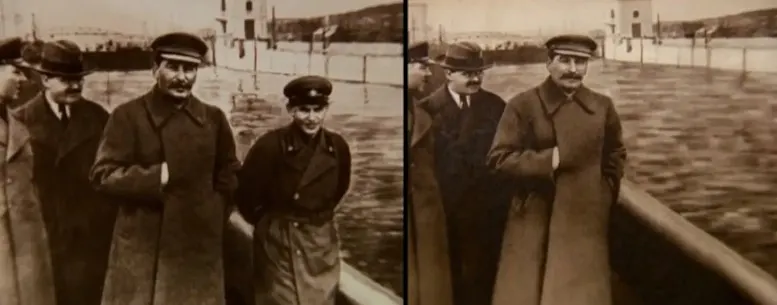
Authoritarian regimes have been equally ruthless. The communist governments of the Soviet Union and China became notorious for airbrushing disgraced figures out of photographs long before Photoshop existed. Nikolai Yezhov, Stalin’s head of the secret police, was removed from official images after his execution in 1940.
Erased for Economy
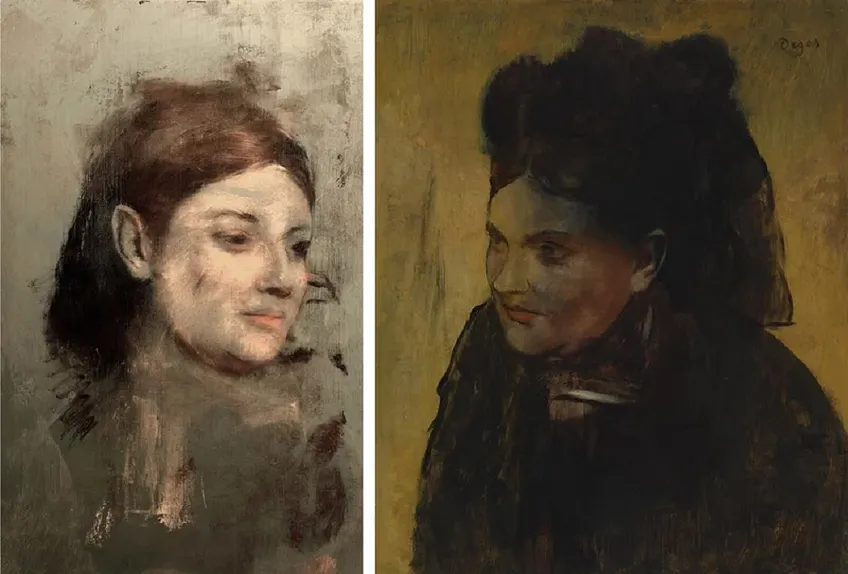
Not every vanished face was a political casualty. Sometimes artists were simply practical. Van Gogh often reused canvases to save money, and Picasso did the same. In 2016, researchers found Emma Dobigny, a favorite model of Edgar Degas who sat for him in 1869–70, hiding beneath his Portrait of a Woman.
Beneath Famous Canvases
Modern techniques such as X-ray and infrared reflectography keep revealing secrets:
- René Magritte: A portrait of a woman, likely his wife, lay beneath La Cinquième Saison (1943). Fragments of the missing La Pose enchantée (1927) were found under other Magritte paintings.
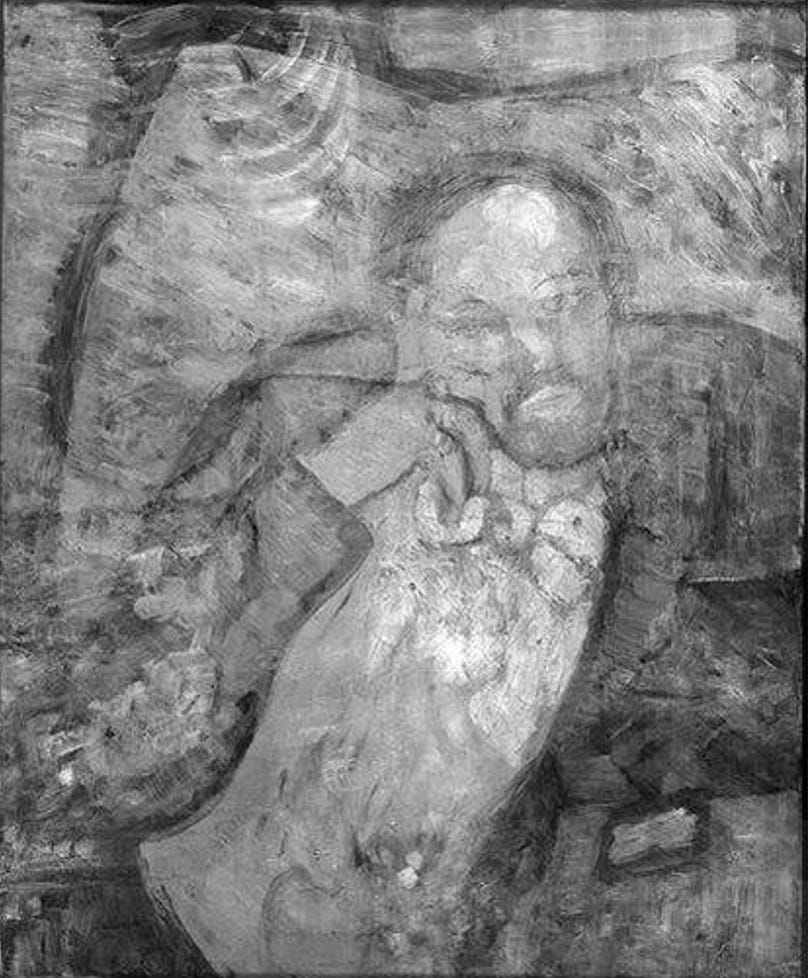
- Pablo Picasso: Infrared imaging exposed a bearded man beneath The Blue Room (1901) and a woman beneath Portrait of Mateu Fernández de Soto (1901).
- Titian: Researchers uncovered a portrait of an unknown mustachioed man under Ecce Homo.
- Leonardo da Vinci: Improved X-ray scans clarified hidden angelic figures beneath The Virgin of the Rocks.
- El Greco: A genuine 1590s painting, The Redeemer, was uncovered beneath a forgery in the Vatican.
- Vincent van Gogh: A self-portrait was found concealed behind layers of cardboard and glue on the back of Head of a Peasant Woman.
More Hidden and Forgotten Treasures
- Van Gogh’s Patch of Grass (2012): Researchers using X-ray fluorescence at the Kröller-Müller Museum revealed a portrait of a woman buried beneath the grassy landscape. It is a haunting reminder of how often he painted over his own work.
- Van Gogh’s Sunset at Montmajour (2013): The large landscape sat unrecognized in a Norwegian attic for decades, dismissed as a fake, until the Van Gogh Museum authenticated it.
- Caravaggio’s Judith Beheading Holofernes (2014): A painting found in the attic of a house near Toulouse, France, was attributed by some experts to Caravaggio. Its authorship is still debated.
- Klimt’s Portrait of a Lady (rediscovered 2019): Stolen from a gallery in Piacenza, Italy, in 1997, the painting was found hidden in an exterior wall cavity of the very museum it was taken from.
- Picasso’s The Old Guitarist: X-ray and infrared studies revealed earlier figures, including a woman and a young animal, painted beneath the melancholy blue musician.
- Michelangelo’s secret room: Beneath the Medici Chapel in Florence, a small hidden chamber was found in 1975 with charcoal sketches covering its walls. It is now open to small groups of visitors.
- Caravaggio’s Young Man with a Carafe of Roses: Art historian Maria Cristina Terzaghi identified it in a Paris gallery and traced it to the 1590s.

The Lost O’Keeffe
The latest artwork to surface after decades of disappearing was a long-lost 1930 landscape by Georgia O’Keeffe, Near Abiquiu, New Mexico I. It was painted in 1930, a year after O’Keeffe moved to New Mexico, and is going up for auction in 2026.
It was in the closet of an East Village apartment in New York City. The small canvas, about 10 by 24 inches, depicts Lobo Peak in northern New Mexico. It had been tucked away in its original box, behind a row of fur coats.
The anonymous owner received the painting in 1963 as a graduation gift from her parents for $3,800. She displayed it in her home for years, but in the mid-1980s she grew uneasy when a guest seemed to study it a little too closely. She boxed it up and hid it in the closet until 2022, when the pair were preparing the apartment for the arrival of home health aides. She mentioned in passing to her visiting niece that an O’Keeffe was in the closet.
It wasn’t until 2026, when she returned to help her since-deceased aunt prepare for hospice, that she finally laid eyes on the artwork itself buried under a pile of furs.
When she made the discovery, Betsy, who asked to be referred to by only her middle name, was shocked.
The back of the original panel bears O’Keeffe’s initials.
Until its rediscovery, the painting was known to the art world from a single 1931 photograph, taken by O’Keeffe’s husband, Alfred Stieglitz.
According to her family, Betsy’s aunt lived a cosmopolitan life. She had no children and died at 98, only weeks after the painting was finally taken from its closet. Her family describes her as a woman of formidable talent. She attended several prestigious colleges and, they say, posted the highest Civil Service Exam score of her day. Her Foreign Service career took her around the world, and she spoke at least four languages. Away from work, she was a world-ranked bridge master. The sport may even have prompted the painting’s hiding.
Christie’s will offer the work at its 20th Century Evening Sale in New York with an estimate of around $3 million. It is believed to be the first of three paintings O’Keeffe made of Lobo Peak, the landscape that would become central to her career. The second is in the Metropolitan Museum of Art, and the third is in a private collection.
Other Lost O’Keeffe Paintings
Three small paintings (Cliffs, Seaweed, Fragments) were stolen in 1946 from Alfred Stieglitz’s New York gallery by an unknown thief. O’Keeffe didn’t find them until 1976, when she tracked them to a dealer, Barry Snyder, in Princeton, New Jersey. That led to O’Keeffe v. Snyder, a court case over who owned the works. New Jersey reversed the lower court’s ruling that had granted possession to O’Keeffe, holding instead that the discovery rule applied to the statute of limitations for stolen art. While the court ruled she could still enforce her right to possession if she was diligent, the final outcome of that retrial is not provided in the available records.
Legalities
Barry Snyder bought the three paintings in March 1975; he purchased them from Ulrich A. Frank for $35,000. The actual theft was committed by an unknown person in 1946 from the An American Place gallery owned by Stieglitz.
The real legal question was whether Snyder was a bona fide purchaser (good-faith buyer) or whether he should have known the paintings were stolen. The record shows several red flags that undercut his good-faith claim:
- He was a professional art dealer (Princeton Gallery of Fine Art) who did not attempt to authenticate provenance or verify ownership before buying.
- The paintings had been listed as stolen in the Art Dealers Association of America registry since 1972 — three years before his purchase — yet he claimed he was unaware of that registry.
- His seller, Frank, did not know how his own father had acquired the paintings, and the provenance was never traced back to O’Keeffe.
- The paintings had been consigned to Snyder’s own gallery in March 1974; when no buyer appeared, he bought them himself a year later.
Stolen and Recovered
Small Red Canna (1919) — the 8×6-inch oil painting — was stolen from the Georgia O’Keeffe Museum in Santa Fe in 2004 by security guard William Crumpton, who staged a fake burglary report to cover it up. Both the painting and $14,000 in cash were recovered by police. Crumpton pleaded guilty on October 26, 2004.

Infamous and Unrecovered
In 1990, thieves posing as police officers stole 13 works from the Isabella Stewart Gardner Museum in Boston, including a Vermeer and two Rembrandts. It is still the largest unsolved art heist in the U.S. The works are now valued at more than $500 million, and the museum offers a $10 million reward. Empty gilded frames still hang on the walls where the paintings were, because the founder’s will forbids any change to the museum. A retired FBI agent says he has “no doubt” the works still exist.
East River from the Shelton (1928)
The Shelton Hotel opened in midtown Manhattan in 1924 as the tallest hotel in the world. O’Keeffe, who lived in the Shelton between 1925 and 1936, took advantage of the view from her apartment on the thirtieth floor to capture this panoramic view of the East River waterfront, looking across to Long Island City, Queens. She moved permanently to New Mexico in 1949.
The Art Institute of Chicago formally classified this painting as lost in 1990 after it failed to turn up in a collection inventory. It had returned from a loan to the Museum of Fine Arts, Houston, in 1966, and when the museum tried to locate it for a Whitney retrospective in 1970, it was gone. The museum stopped short of calling it stolen but notified federal and international authorities. No public record confirms it was ever recovered.
Condemned But Not Forever
From a Scottish lord’s black doublet to the back of an East Village closet, these discoveries share one truth: a painting rarely tells its whole story on the surface. Mary, Queen of Scots was painted out because her face had become too dangerous to display. Vermeer’s Cupid vanished from the wall behind his letter reader because a later owner found it unsuitable. Bianca Cappello was erased from her family’s tombs and portraits by a brother-in-law who wanted her forgotten. Whether the motive was politics, propriety, or simple thrift, the instinct was the same, and the Romans gave it a name: damnatio memoriae, the condemnation of memory.
Yet memory has proved harder to condemn than the censors hoped. Paint thins and fades, and what lies beneath begins to show. Today X-rays and infrared cameras read through layers of pigment that no one was supposed to disturb. They have returned a queen to her canvas and restored a missing portrait to Magritte. They have even uncovered the faces Picasso and Van Gogh painted over when money ran short. Other works were never painted over at all. They were only boxed up and left in the dark.
That is the lesson of Georgia O’Keeffe’s Near Abiquiu, New Mexico I. For about forty years it sat behind a row of fur coats, kept by a fiercely private woman who knew exactly what she owned and chose to say nothing. It surfaced only because she mentioned it in passing to her niece. Now it goes to auction at Christie’s, where it is estimated to bring around $3 million.
Not every hidden image is a mystery, and not every lost picture is a masterpiece. But each one is a reminder that history is revised by the people who hold the brush, the chisel, and the key to the closet. Sooner or later, someone looks closer.