The Exorcists of Rome

by M.P. Pellicer | Noir Notebook

Noir Notebook

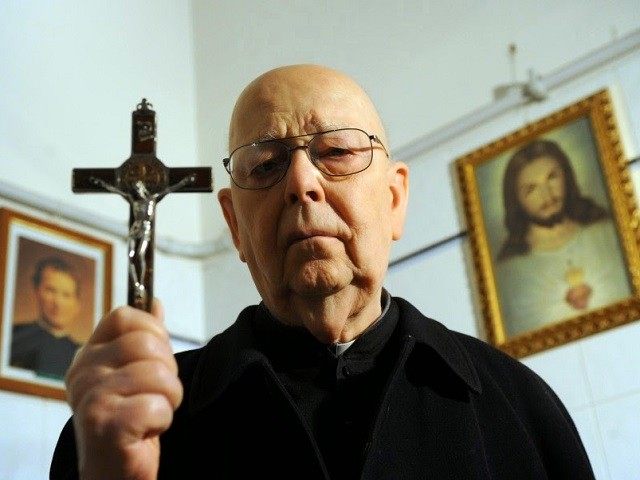
On September 16, 2016, in Rome, one of the world’s most feared and revered exorcists drew his final breath. Gabriele Amorth died at the age of 91—after decades spent confronting what he believed lurked beyond the veil.

From 1986 until his death, he served as the chief exorcist of the Diocese of Rome, facing cases many would not dare to name. In 1994, he helped establish the International Association of Exorcists—a shadowed network of priests trained to battle forces few openly acknowledge. He led it until 2000, then remained its honorary president, a title that followed him to the grave.

Even in death, his legacy lingers—rooted in the chilling question: what did he truly encounter… and what followed him back?

Father Gabriele Amorth

For 27 years, Vincenzo Taraborelli served alongside Gabriele Amorth as an exorcist for the Diocese of Rome. He never sought the role. It found him.

“I didn’t know what it was. I hadn’t studied it,” he once admitted. “He told me what to do. I was completely ignorant.”

What began as a reluctant favor became a lifelong descent into something few are willing to confront. Once a protégé of Amorth, Taraborelli stepped into his mentor’s place and became one of Rome’s busiest exorcists. Three days a week, behind the Vatican, he works from a windowless room—receiving as many as 30 people a day.

The room itself feels suspended between worlds. Statues of angels watch from the corners. A drawer holds small pieces of candy for visitors. His desk is cluttered with photographs, scattered papers, and a worn copy of the Church’s exorcism rites—its spine taped together to keep it from falling apart. Nearby rests a simple cross, the instrument he raises when the ritual begins.

He proceeds cautiously. “Before anything, I tell them to see a psychologist or psychiatrist,” he explains. “I ask for a diagnosis. I work with many who send patients here.”

But not everything, he suggests, can be explained away.

“When they arrive,” he says, “many are already disturbed.”

One case stayed with him—a married woman he treated for 13 years. According to Taraborelli, a man involved in occult practices had become obsessed with her. When she rejected him, he threatened revenge. Soon after, she began to change.

“When I started to pray, she entered a trance,” he recalled. “She shouted insults… blasphemies. I understood quickly—something was there.”

As the rites continued, her condition worsened. Then came the moment he cannot forget.

“When I commanded, ‘In the name of Jesus, leave her,’ she began to vomit… metal pins. Five at a time. Then hair, small stones, pieces of wood.”

He paused.

“It sounds like something from another world,” he said quietly. “But it happens in this one.”


Father Vincenzo Taraborelli

For over 2,000 years, exorcism has remained a recognized practice within the Catholic Church. Yet many dismiss such accounts as superstition—or the misdiagnosis of mental illness.

Taraborelli sees it differently. “Those who do not believe in the devil will never see him,” he said. “But those who believe… they recognize the signs. Look at the world. The violence—it is not human.”

His words echo against a backdrop of real horror. In 2016, Jacques Hamel, an 84-year-old priest, had his throat slit by two Islamic State (IS) terrorists in 2016 as he was saying Mass in Rouen. The attackers,  Adel Kermiche and Abdel-Malik Petitjean, both aged 19, stormed the church, took hostages, including three nuns and two parishioners, and recorded the killing before being shot by police. Father Hamel was reportedly heard saying “Get away, Satan” before his death.

For Taraborelli, the battle is not only against what he calls “the father of lies,” but also against silence—and fear within his own ranks.

“I told the bishop I cannot find anyone willing to do this,” he admitted. “Many are afraid. Even priests are afraid. It is a difficult life.”

He continues his work inside Santa Maria in Traspontina, a church built in the 16th century along the Via della Conciliazione. Few who pass by realize what unfolds behind its walls.

The ground beneath it holds older secrets. The church stands near the site of the ancient Meta Romuli, a pyramid once believed to mark the tomb of Romulus. It was torn down centuries ago, its stones scattered, its memory buried.

Yet the shadows linger.

In October 2019, the church became the center of another controversy. Statues of Pachamama—a fertility figure from South America—were placed inside during the Amazon Synod. Days later, they vanished, only to be discovered in the waters of the Tiber River.

Recovered. Returned. Displayed again.

A coincidence, perhaps.

Or something else entirely—something drawn, once more, to the very place where Rome’s battle against the unseen continues in silence.

The Catechism of the Catholic Church No. 2851 teaches: “evil is not an abstraction; instead it points to a person: Satan, the evil one, the angel who opposes God. The devil ‘diá-bolos’ is he who throws himself sideways to God’s plan and to his work of salvation accomplished in Christ”.


Church of Saint-Étienne-du-Rouvray Normandy, France where Fthr. Hamel was killed

In 2022, Father Tababorelli was interviewed, and asked which was his most difficult case. He responded:

“In this very room where we are, I had a young woman who lived with her husband; she was extremely violent, she hated people terribly even though she was, fundamentally, good. The tragic fact is that she frequented magicians, fortune tellers a lot, and this is a path that, without realizing it, leads us into the soil of Satan, who silently insinuates himself, at the beginning, into our lives. And so, give today, give tomorrow, for every problem you have, go to these occult workers, workers of the devil. This woman had fallen for it and I followed her for ten years. She became very violent, but she never touched me, because the Lord protects people who make themselves available to Him for the good of others. This woman was beautiful, once a magician approached her and said: ‘leave everything and come with me’.’ This one had two kids and she said, ‘Are you crazy? I love my husband so much, I have two daughters, I will never come with you.’ And he says to her, ‘Yet you will come there. You will come with me’’. And from that day on, this one started to feel a little’ bad. He cursed her, he gave her to the devil; he was also part of a satanic sect that celebrated black masses for this woman, who eventually capitulated and, subjugated by his evil influence, gave herself entirely to that magician.”


Witnesses reportedly said they saw the woman levitate before crashing to the ground and throw a church pew at an altar. The couple, who have two children, were granted a “no-fault” divorce by the court, which ruled that the woman was not consciously acting when under the “possession.”

He was asked if there was a change of voice in the possessed person and he said:

“Yes, yes it changes…a hoarse, metallic, scratched, animalistic voice takes over: at first they seem like a kind man or woman but then, being possessed, they throw out a horrible voice, with blasphemies, screams, curses. If only he knew the ‘fuck’ he throws at me every time, the swear words, the insults …”


In the past, Father Taraborelli has expressed concern about the shortage of priests willing to become exorcists. Father Amorth, who was ordained a Roman Catholic priest in 1954, wasn’t appointed to be the assistant to the Vatican’s chief exorcist, Candido Amantini, until 1986, when he was 61. He spent six years training under Father Candido before taking over as chief exorcist in 1992, when Father Candido died. 

Father Taraborelli admits it’s a difficult life, but at the same time, how is the rising demand for exorcisms to be met? He is already more than 80 years old. Who will step into his shoes when he is gone? 

This concern of the diminishing number of exorcists is not just Father Taraborelli’s worry, but also for other exorcists as well. In March 2026, representatives from the Association of Exorcists (AIE), Father Francesco Bamonte and Monsignor Orlita, urged the Pope to ensure that every diocese in the world has “one or more adequately trained exorcist priests”. They cited the surge in occult and satanic practices around the world. Their message is clear: Reinforce the number of exorcists.